
Every blueprint ships with source code, sample data, and step-by-step instructions — ready to run on your Cloudera Platform
Financial Services
Improving TCO for Fraud Detection Models
Quantifies the real cost of private inference for fraud detection and compares it directly with equivalent cloud API pricing, helping organizations understand when on-premises AI delivers a meaningful cost advantage.
-
Blueprint Card
Overview
Reduce the cost of fraud detection while improving risk visibility and accelerating investigations with Cloudera AI and NVIDIA.
Financial institutions face a constant challenge: identifying fraudulent transactions without overwhelming analysts, disrupting legitimate customers, or increasing operational costs. Traditional fraud detection approaches often struggle to balance detection accuracy, investigation effort, and infrastructure efficiency.
The Improving TCO for Fraud Detection Models Blueprint combines Cloudera AI with NVIDIA-accelerated computing to demonstrate an intelligent, cost-conscious approach to fraud prevention. Using machine learning, explainable risk scoring, and an AI-powered investigation assistant, organizations can identify suspicious transactions, understand the factors driving fraud predictions, and evaluate the operational trade-offs of different detection strategies. By bringing these capabilities together, financial institutions can improve fraud operations, optimize AI infrastructure utilization, and make more informed decisions about the cost of detecting and preventing financial fraud.
Business Value:
Improve the total cost of ownership of fraud detection with Cloudera AI and NVIDIA, reducing investigation overhead, optimizing AI infrastructure utilization, and minimizing fraud-related losses through explainable machine learning, intelligent investigations, and cost-aware risk management.
Cost Savings - Reduce fraud investigation costs by prioritizing high-risk transactions and automating routine analysis; Improve investigator productivity through AI-powered fraud insights and explainable risk scoring; Optimize fraud detection operating costs by evaluating detection thresholds against investigation effort and potential losses; Improve AI infrastructure efficiency through flexible CPU and NVIDIA GPU-accelerated processing.
Cost Avoidance - Reduce financial losses from fraudulent transactions through earlier identification of suspicious activity; Minimize unnecessary investigations and customer friction caused by false-positive alerts; Reduce operational risks by providing transparent, explainable fraud predictions; Avoid inefficient AI infrastructure investments through greater visibility into processing requirements and AI usage costs.
Revenue Growth - Protect transaction revenue by reducing fraud-related losses and unnecessary payment disruptions; Improve customer retention through more accurate fraud detection and fewer unnecessary transaction interruptions; Accelerate deployment of new financial services through reusable AI-powered fraud analytics; Support growth in transaction volumes without proportional increases in fraud investigation staffing.
Demo
This interactive demonstration showcases how financial institutions can use Cloudera AI and NVIDIA to improve fraud detection while evaluating the costs associated with investigation and AI operations.
Explore a fraud analytics dashboard that analyzes transaction activity, identifies suspicious behavior, and assigns risk scores to help investigators prioritize potential fraud. See how explainable AI provides insight into why individual transactions were flagged, allowing analysts to investigate suspicious activity with greater confidence.
The demonstration also highlights an AI-powered investigation assistant that answers natural-language questions about fraud activity, along with tools for evaluating detection thresholds, exploring fraud patterns, and monitoring AI usage costs. Together, these capabilities illustrate how organizations can improve fraud detection effectiveness while making more informed decisions about operational efficiency and AI investments. Watch the demo
Key Features
AI-Powered Fraud Detection: Analyze financial transactions using machine learning to identify suspicious activity and prioritize potentially fraudulent transactions for investigation.
Explainable Fraud Predictions: Understand the factors contributing to each fraud risk score, helping investigators make more informed decisions and improving transparency in AI-driven detection.
Cost-Aware Operation: Evaluate how different fraud detection thresholds affect investigation volume, missed fraud, and operational costs to support more efficient risk management.
Interactive Risk Analytics: Monitor fraud trends, transaction activity, risk indicators, and suspicious relationships through a centralized dashboard.
Flexible AI Infrastructure: Run fraud analytics using CPU-based processing or optional NVIDIA GPU acceleration, providing flexibility to match infrastructure resources with workload requirements.
AI Usage Cost Visibility: Monitor AI-agent token consumption and estimated usage costs to better understand the economics of AI-assisted fraud investigations.
Rapid Deployment: Accelerate adoption with a ready-to-deploy Cloudera AI application that includes sample transactions, fraud prediction models, and investigation tools.
Use Case
Financial institutions must detect increasingly sophisticated fraud while managing the costs of investigations, false positives, and AI infrastructure. Traditional fraud detection systems can generate large volumes of alerts without providing sufficient context, forcing analysts to spend valuable time investigating potentially legitimate transactions. The Improving TCO for Fraud Detection Models Blueprint addresses these challenges by combining machine learning, explainable risk scoring, and AI-powered investigations on Cloudera AI, with optional NVIDIA acceleration to improve processing efficiency. By helping organizations detect suspicious activity, understand fraud predictions, and evaluate the cost implications of detection strategies, financial institutions can reduce investigation overhead, improve fraud prevention, and make more informed investments in their AI infrastructure.
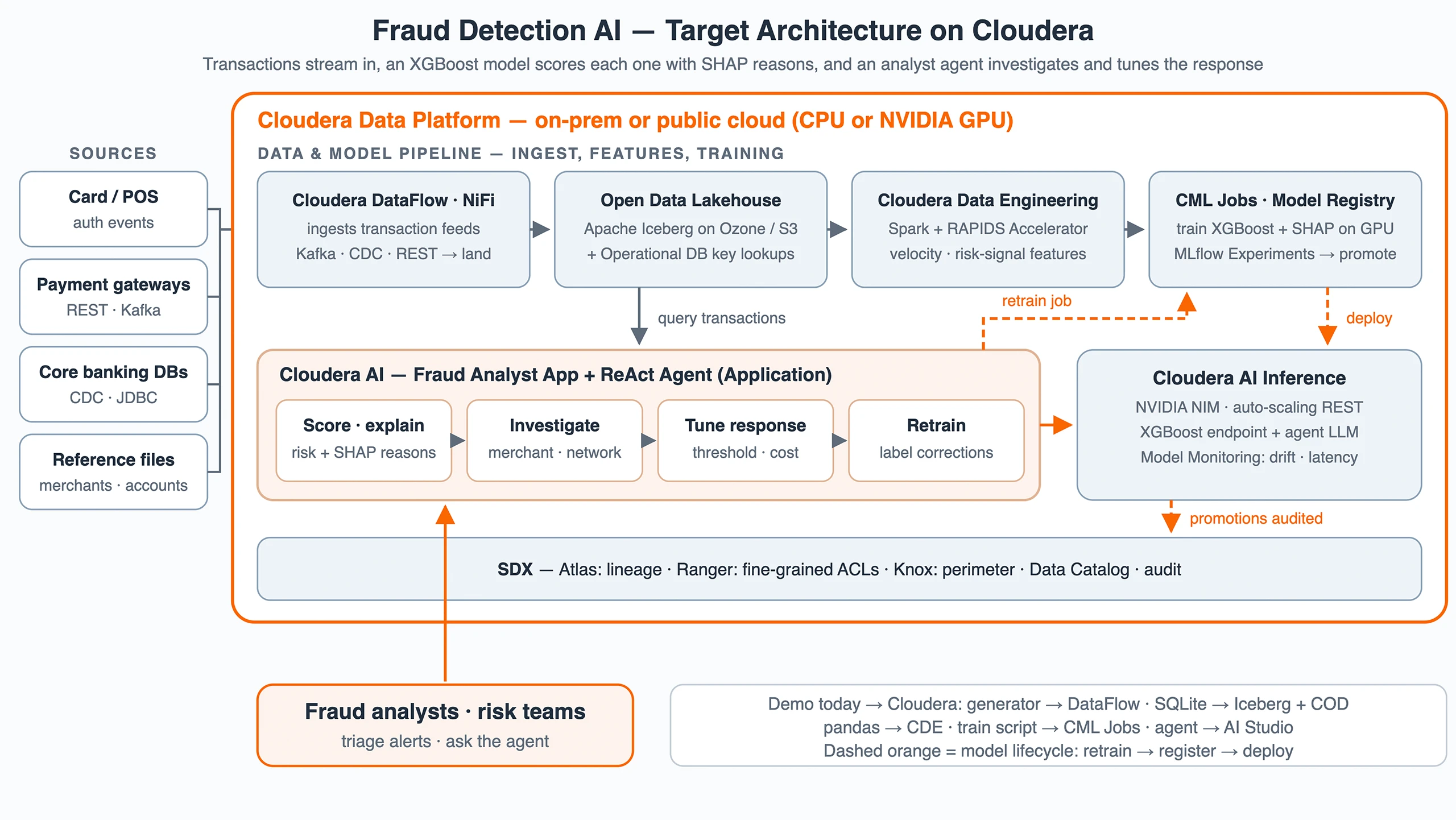
Architecture
Powered by Cloudera AI Inference and Workbench for accurate cost modeling and private LLM inference deployment.
Your form submission has failed.
This may have been caused by one of the following:
- Your request timed out
- A plugin/browser extension blocked the submission. If you have an ad blocking plugin please disable it and close this message to reload the page.