
The Document Data Bottleneck in Enterprise AI
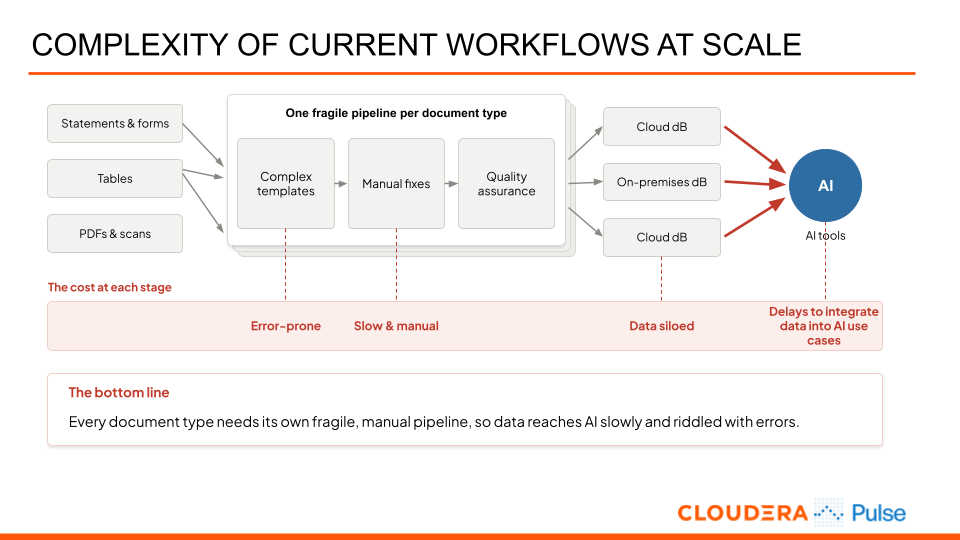
While unstructured data accounts for approximately 80% of total enterprise data, it is heavily underutilized in data analytics and AI use cases. Organizations are dealing with an explosion of complex PDFs and scanned records that traditional Optical Character Recognition (OCR) tools and general-purpose Large Language Models (LLMs) struggle to process accurately at scale. The legacy approach relies heavily on brittle, template-based OCR that breaks on document variability, handwriting, or poor scans, leading to significant manual review bottlenecks. On the other hand, general LLMs often lose document structure, lack citations, and pose a real risk of hallucinating values. Furthermore, critical data remains trapped in architectural silos characterized by fragmented, coarse-grained security models.
These challenges prevent the integration of document data into AI use cases due to high error rates that can pose regulatory risks (e.g., a misread coverage limit in a claims file creating legal exposure) and high unit costs for document extraction and processing, which limit the adoption of high-volume document data into AI/ML use cases. In addition, manual reviews, disparate data silos with heterogeneous schemas, and varying security governance mechanisms introduce delays in making that data available for AI/ML use cases, given the numerous ETL pipelines needed to standardize extracted outputs under a common schema and convert them into features.
The Cloudera and Pulse Partnership: A Reference Architecture for document AI at Scale
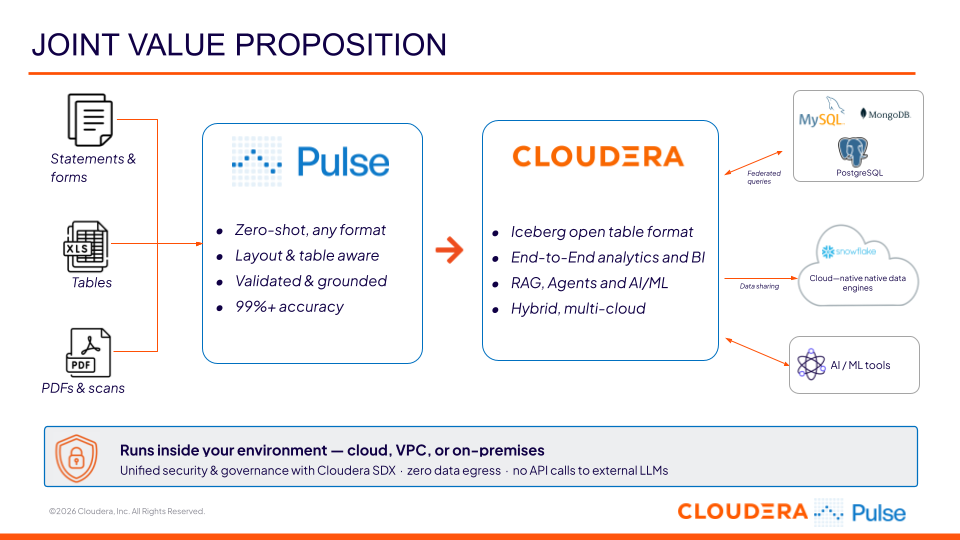
Cloudera and Pulse are partnering to deliver document extraction and processing at scale that overcomes limitations of legacy approaches:
Pulse replaces multiple data extraction pipelines for complex PDFs, handwritten notes, tables and charts with a single multi-stage and multi-model pipeline that delivers highly accurate, audit-ready data. Each data extraction step is run by a model built for that exact job, and the “Pulse Brain” is able to understand semantic context and document layout, reasoning over the results to catch errors before output.
Cloudera provides a centralized, open data lakehouse and enterprise AI platform that integrates data streaming, data engineering, data warehousing, and ML/GenAI at scale with a unified security and governance layer through SDX. This framework features attribute-based data access controls, lineage, and active metadata enrichment and cataloging.
This combination creates a unified technology architecture that integrates structured and unstructured document data (processed through Pulse) under a common security and governance framework using a single pane of glass across different public and private cloud environments. The architecture enables standardizing feature engineering workflows across disparate and diverse data sources and cross-pollinating structured and document data in AI/ML use cases. In addition, it delivers a unified data-sharing layer that exposes structured and document data to external tools on-premises or in the cloud.
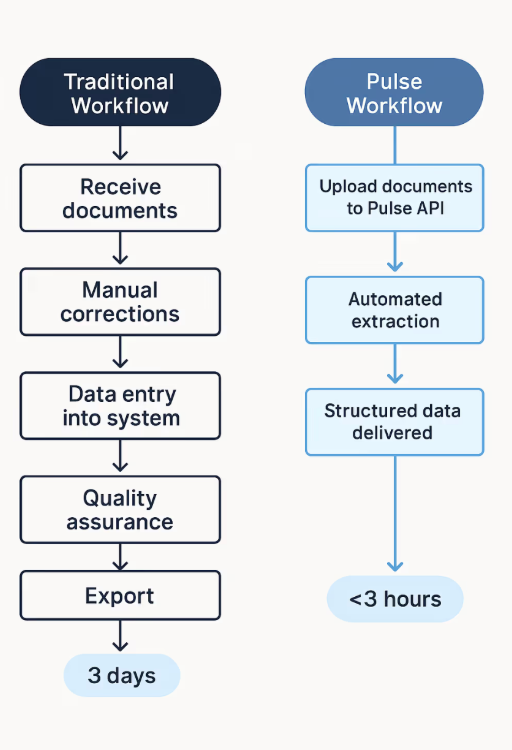
Additionally, the joint value proposition minimizes time to integrate document data into AI use cases by eliminating manual corrections and quality assurance tasks that would typically take up to three days, compressing the extraction timeline to less than three hours:
Cloudera delivers improvements on data engineering and LLM inferencing workloads of up to 20x and 36x, respectively. Similarly, Pulse employs several GPU and CPU optimizations to minimize the unit cost of extraction, increasing GPU utilization by 30%.
Built for Sensitive Data and Regulated Industries
In regulated industries such as Financial Services and Healthcare, the cost of a silent extraction error is measured in millions of dollars or in regulatory exposure rather than being a simple quality issue. For instance, a misplaced decimal point or a period interpreted as a comma could lead to significant AML/KYC verification errors, resulting in substantial regulatory fines.
The Cloudera and Pulse solution is explicitly designed for sensitive data and regulated industries; it can be fully deployed in a customer’s virtual private cloud (VPC) with no public egress for document extraction or advanced analytics.
Pulse provides a production-grade approach to data verifiability by ensuring that every extracted field is grounded directly back to its exact location on the source page, preserving context and hierarchical relationships that guarantee almost flawless document extraction. Specifically for spreadsheet data, it can capture layout, formatting conventions, and finance-specific nuances to overcome the limitations of legacy approaches (e.g., dropping hidden columns, dealing with hierarchical data, etc.).
Cloudera’s open data lakehouse delivers a fine-grained data security mechanism through SDX that addresses stringent regulatory requirements, such as GxP compliance in life sciences. Cloudera Data Lineage tracks deep structural data relationships from the raw scanned document down to vector database entries, creating compliance-ready tracking records.
Serving as a Force Multiplier for AI Initiatives
The joint value proposition is particularly relevant for AI initiatives, as AI model capabilities become heavily commoditized, the true competitive differentiator for an enterprise has shifted dramatically away from raw model access to proprietary data. Cloudera and Pulse help enterprises securely unlock this massive competitive moat by turning unstructured document repositories into pristine, actionable assets. Together, Cloudera and Pulse radically improve the semantic accuracy of vector searches in Cloudera RAG Studio, converting highly sensitive, proprietary document databases into a comprehensive foundation for secure business intelligence and advanced agentic pipelines.
Delivering Business Value at Scale
In enterprise deployments, Pulse has delivered unprecedented results compared to legacy document extraction approaches.
For a top electric utility company, it converted 1.2M handwritten field documents, achieving 97.5% accuracy for data that no system could accurately digitize for decades. For a top insurance broker, it was the first system that consistently delivered 99% accuracy on document data processed by multiple offshore teams, cutting down the time to develop a complete, auditable structured output by 76%.
Learn more about Cloudera capabilities and the Pulse platform.