
Every blueprint ships with source code, sample data, and step-by-step instructions — ready to run on your Cloudera Platform
-
Blueprint Card
Overview
This blueprint shows how to build, evaluate, and monitor a multi-agent chatbot on Cloudera AI, using a credit-card Next-Best-Action (NBA) assistant as the worked example. The demo user plays a customer who opens a chat and explains why they’re getting in touch. A LangGraph multi-agent system extracts what it learns from each message and asks short clarifying questions about goals, income, and employment. Conversation state is checkpointed per thread, so each session carries its context from turn to turn. Customers can keep asking follow-up questions once an offer is on the table, and the answers stay grounded in that offer’s details.
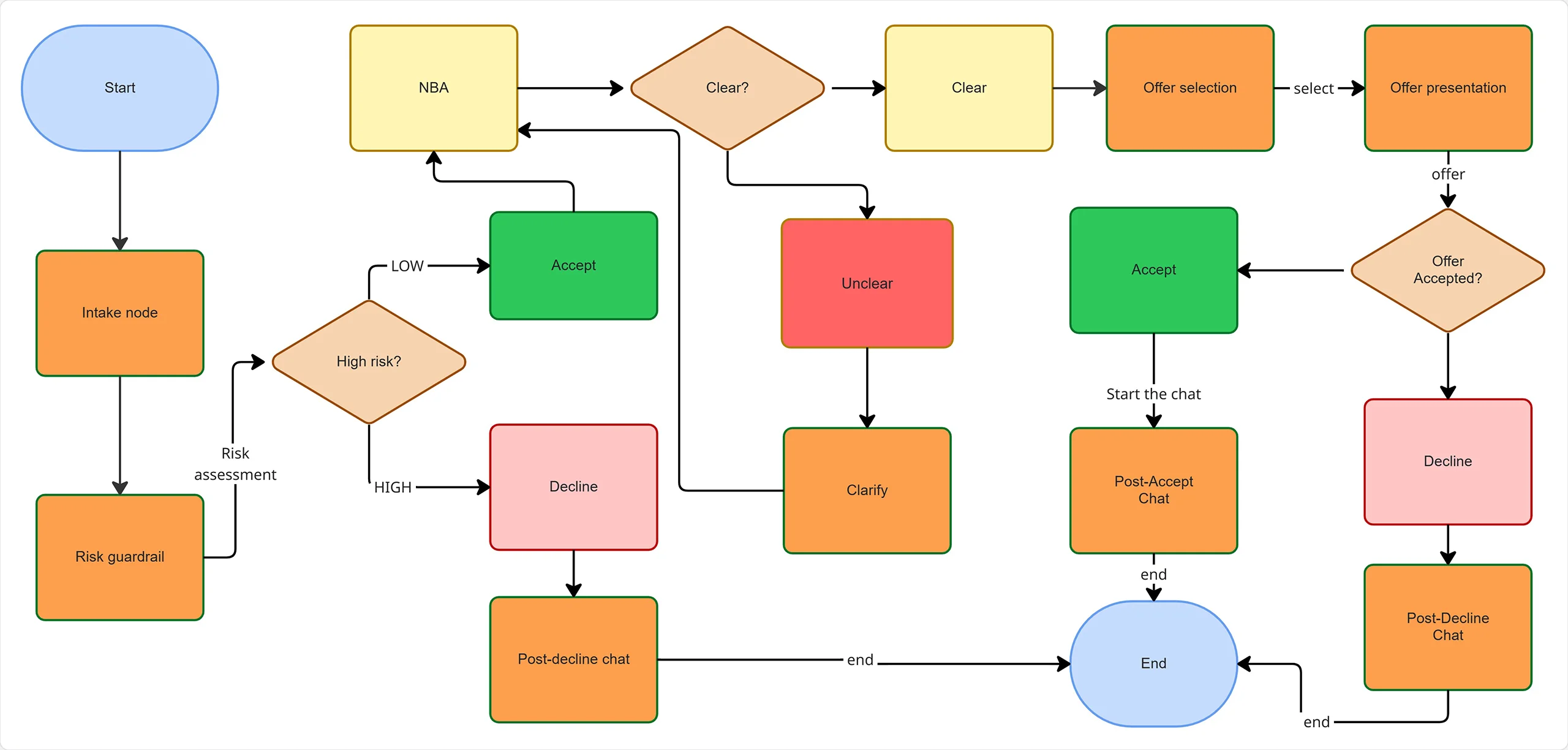
The system keeps decisions that matter out of the language model’s hands. Before any routing happens, a customer-risk guardrail scores the customer’s profile against their risk tier, debt-to-income ratio, and employment status. High-risk customers get a polite decline that quotes no product terms and directs them to a human agent. For everyone else, an intent router decides whether to keep asking questions, make an offer, or answer follow-ups. A rule engine then selects the offer from a SQL-backed catalog, filtering by eligibility (risk tier, age, income) and ranking by fit. Nemotron writes the pitch, but the rules choose the product. The guardrail ships as a rules-based scorer, and an XGBoost or PyTorch classifier, exported to ONNX and served on Cloudera AI Inference Service, is included as an optional drop-in replacement.
Observability is part of the design from the start. Each turn is a root run in LangSmith, with every agent step nested beneath it. Turns are grouped into conversation threads, and the thumbs-up or thumbs-down a customer gives attaches to the exact turn it refers to. Three notebooks turn scripted conversations into a repeatable evaluation suite. They replay conversations through the live agent and score offer accuracy, guardrail behavior, offer relevance, and conversation quality, using deterministic checks and LLM-as-judge evaluators side by side. The stack is Nemotron on Cloudera AI Inference Service and a FastAPI service with a lightweight TypeScript UI, deployed as a Cloudera AI Application with no build step. Together they provide reference wiring for any agentic application on the Cloudera platform that needs evaluation and monitoring.
Demo
The demo has two sides. Customers see a simple chat. Product, risk, and engineering teams see everything happening behind it. To start, pick a customer from a slate that spans low, medium, and high risk tiers. A low- or medium-risk customer gets a few clarifying questions and then a tailored card offer. A high-risk customer is screened out at the first turn and politely directed to a human agent. A live panel beside the chat tracks the agent as it works: the current workflow stage, the customer’s risk score against the guardrail threshold, how many clarifying questions have been used, and which offer was selected.
In LangSmith, every turn appears as a traced run with its latency and token count. Turns from the same chat are grouped into one conversation thread, and the thumbs-up or thumbs-down from the chat is attached to the specific reply it rated. Opening any turn shows the full chain of agent steps behind it, so an unexpected recommendation can be traced to the exact step that produced it. The same view holds offline experiments on a golden dataset of scripted conversations, so teams can compare a new prompt or model against the current one before it goes live. Watch the demo
Key Features
Multi-turn LangGraph Multi-Agent System. The application processes incoming customer inquiries and proactively upsells credit card offers based on customer preferences.
Customers are filtered by risk and rerouted to a different marketing channel if needed. Agents interact with the customer and consult an internal rule engine to come up with the best credit card offer for upsell.
Agent decisions are tracked in real time via LangSmith Observability where stakeholders can monitor interactions and agent performance. Conversations tracked as root runs featuring nested runs to evaluate every piece of the interaction into a coherent logical thread.
Use Case
Banks and card issuers use chat to offer upgrades and cross-sells, but three requirements keep a general-purpose LLM chatbot from handling that traffic:
Regulated recommendations. Every offer must be tied to a rule-based eligibility check on risk tier, age, and income, not left to the LLM’s judgment alone.
Fail-safe decline path. High-risk customers must be routed to a polite decline that quotes no specific product figures and redirects them to a human agent.
Auditability. Product, risk, and compliance teams need to inspect every conversation turn by turn, replay it against new prompts, and grade it offline before promoting a model change.
This blueprint meets all three by separating the conversation from the decision: the LLM talks, a rule engine and risk guardrail decide, and LangSmith records and grades every turn. The result is a personalized offer channel that runs at chat scale while staying explainable to the teams accountable for it.
Architecture
The blueprint is built from five components. Four run on Cloudera AI, and LangSmith provides the observability layer:
Multi-agent system: the NBA engine, built as a LangGraph workflow. Each customer message passes through intake, risk screening, and intent routing, then on to a clarifying question, an offer, a follow-up answer, or a decline. Conversation state is checkpointed per thread.
Agent observability: LangSmith traces every turn as a root run, with each agent step nested beneath it. Turns are grouped into conversation threads, customer feedback is stored against each reply, and offline evaluation experiments run here too.
Model serving: Cloudera AI Inference Service hosts the Nemotron LLM behind every language step: extracting customer details, routing, asking questions, pitching offers, and judging evaluations. It can also serve the optional XGBoost or PyTorch risk classifier, exported to ONNX.
Data & metadata: the customer profile table that drives the risk guardrail, and the offer catalog with its eligibility rules, which feeds the rule engine. Both use SQLite in the demo.
Web layer: a FastAPI service that exposes the agent as a JSON API and serves a lightweight TypeScript chat UI from a single port. It’s deployed as a Cloudera AI Application with no build step.
Your form submission has failed.
This may have been caused by one of the following:
- Your request timed out
- A plugin/browser extension blocked the submission. If you have an ad blocking plugin please disable it and close this message to reload the page.