
Every blueprint ships with source code, sample data, and step-by-step instructions — ready to run on your Cloudera Platform
-
Blueprint Card
Overview
This blueprint enables developers to run Claude Code—Anthropic's agentic terminal coding assistant—directly within Cloudera AI Workbench while maintaining complete data privacy. By leveraging a custom Workbench runtime preinstalled with Claude Code and an embedded LiteLLM proxy, Anthropic API requests are seamlessly translated to OpenAI-compatible endpoints on Cloudera AI Inference (CAII). All model interaction remains securely hosted on private infrastructure, eliminating the need to transmit code, prompts, or sensitive IP to external third-party model APIs.
From a business and operational standpoint, this integration drives key value across Revenue Growth, Cost Savings, and Cost Avoidance. It accelerates developer velocity and time to market while streamlining delivery workflows and reducing costly rework through consistent code quality controls. Furthermore, keeping AI traffic strictly within enterprise boundaries mitigates data-sovereignty risks, ensures regulatory compliance, optimizes existing hardware utilization, and provides predictable infrastructure costs.
Demo
This demo showcases how to run Claude Code's agentic coding experience inside Cloudera AI Workbench using privately hosted models on Cloudera AI Inference. It utilizes a local proxy to seamlessly translate Anthropic API requests into OpenAI-compatible endpoint calls without routing traffic through external cloud APIs. Watch the demo
Key Features
Pre-configured workbench environment with Claude Code, LiteLLM, and standard developer tools ready to use
Ready-to-use container image eliminates the need to build setup files manually
Automated setup using environment variables
(CAII_*)without saving security tokens to diskBuilt-in proxy translates Anthropic API requests directly to Cloudera AI Inference endpoints
Automatic session authentication fallback when explicit API tokens are not provided
Use Case
Problem: Teams want Claude Code's agentic workflow (shell, edits, search) on models they operate inside Cloudera, with CDP authentication and existing CAII deployments—without routing traffic through Anthropic's cloud API.
Outcome: Deploy a private model on CAII, register this runtime, set three env vars, and get started agentic coding in a workbench terminal.
Architecture
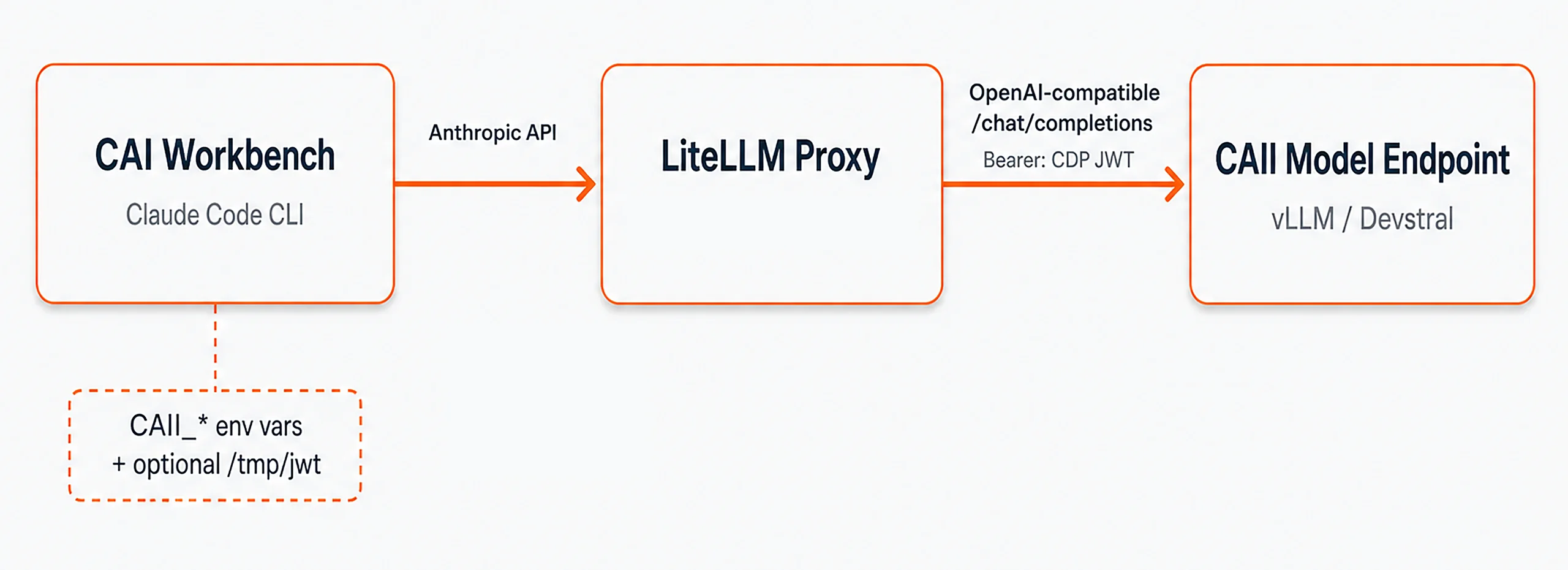
This runtime routes requests from Claude Code running in Cloudera AI Workbench through a LiteLLM proxy, which securely translates Anthropic API calls into OpenAI-compatible endpoints using CDP JWT authentication for private CAII model inference.
Your form submission has failed.
This may have been caused by one of the following:
- Your request timed out
- A plugin/browser extension blocked the submission. If you have an ad blocking plugin please disable it and close this message to reload the page.