
Every blueprint ships with source code, sample data, and step-by-step instructions — ready to run on your Cloudera Platform
-
Blueprint Card
Overview
The New Item Evaluation blueprint is a sequential agentic workflow that helps grocery and CPG retailers decide which new products from suppliers belong on the shelf. A supplier submits a proposed item with a product image and details such as name, brand, price, category, and claims. The system evaluates the proposal against the retailer’s existing assortment and returns a recommendation to authorize, modify, or decline, along with a confidence score and supplier feedback.
The evaluation runs in two phases. First, a fast deterministic step embeds the product’s image and text, searches the full catalog for the closest look-alikes, identifies the category the product belongs to, and gathers sales, category, and vendor data. A rules-based engine then sets the verdict based on how closely the new item overlaps existing products and whether its category is already full. Second, three AI agents build the case behind that verdict. They assess cannibalization risk and market context, flag declining or underperforming SKUs the new item could replace, project best-, expected-, and worst-case revenue, and recommend price, placement, and rollout.
What sets this blueprint apart is multimodal search. Because OpenSearch indexes CLIP image-and-text embeddings, the system recognizes products that look alike on the shelf, not just products with similar descriptions. The final decision comes from a transparent rule rather than an LLM, and agent outputs are checked against the underlying data, so every verdict is consistent, auditable, and backed by reasoning merchants can trust.
This project unifies fragmented network data into a trusted foundation, improving performance, reducing costs and accelerating analytics and AI.
Demo
In this demo, a supplier submits a new grocery product and AI on Cloudera evaluates it against the retailer’s existing assortment in about a minute. CLIP image-and-text embeddings and OpenSearch vector search find the closest look-alike products on the shelf. A rules-based engine then sets an authorize, modify, or decline verdict, and three CrewAI agents explain it with a cannibalization risk assessment, replacement candidates among underperforming SKUs, and best-, expected-, and worst-case revenue projections. Progress streams live as each step completes, and reviewers can ask follow-up questions about any recommendation.
Watch the demo
Key Features
Multimodal visual similarity search. CLIP embeds each product's image and text together, and OpenSearch k-NN search finds look-alike products already on the shelf, so the system compares what products look like, not just their descriptions.
Auditable, deterministic verdicts. The AUTHORIZE, MODIFY, or DECLINE decision comes from a transparent rule based on overlap and category saturation, while AI agents write the cannibalization, market, and financial analysis that supports it. The same product always gets the same verdict.
End-to-end on Cloudera. It deploys as a one-click AMP in a Cloudera AI Workbench. Agents call open-weight models on Cloudera AI Inference, and retail data is queried as Iceberg tables through Cloudera Data Warehouse Impala.
Use Case
Category management: screen new items before line reviews. Each supplier proposal is compared visually and semantically to the current assortment, flagging items likely to cannibalize existing SKUs and highlighting white-space opportunities where the category has room.
Assortment planning: make room for winners. When a new item overlaps the shelf, the system identifies declining, clearance, seasonal, or bottom-shelf SKUs it could replace and calculates the net revenue impact of the swap.
Merchandising operations: triage the queue at scale. Batch evaluation processes a backlog of proposals at once, so buyers can spend their time on the submissions that need human judgment.
Category finance: see the numbers before committing. Best-, expected-, and worst-case revenue projections, along with a suggested retail price, placement, and rollout plan, help teams weigh each decision against category margins.
Supplier and vendor management: give clear, consistent feedback. Modify and decline verdicts come with specific feedback suppliers can act on before resubmitting, and vendor performance data such as fill rate and on-time delivery informs every evaluation.
Governance and audit: explain every decision. Verdicts follow a transparent rule, so the same product in the same category gets the same outcome, and follow-up Q&A lets reviewers question the reasoning behind any recommendation.
Beyond grocery: reuse the pattern. Multimodal similarity search combined with rules-based decisions and agent-written analysis carries over to private-label development, apparel and beauty line planning, and any category where how a product looks on the shelf matters as much as its specs.
Architecture
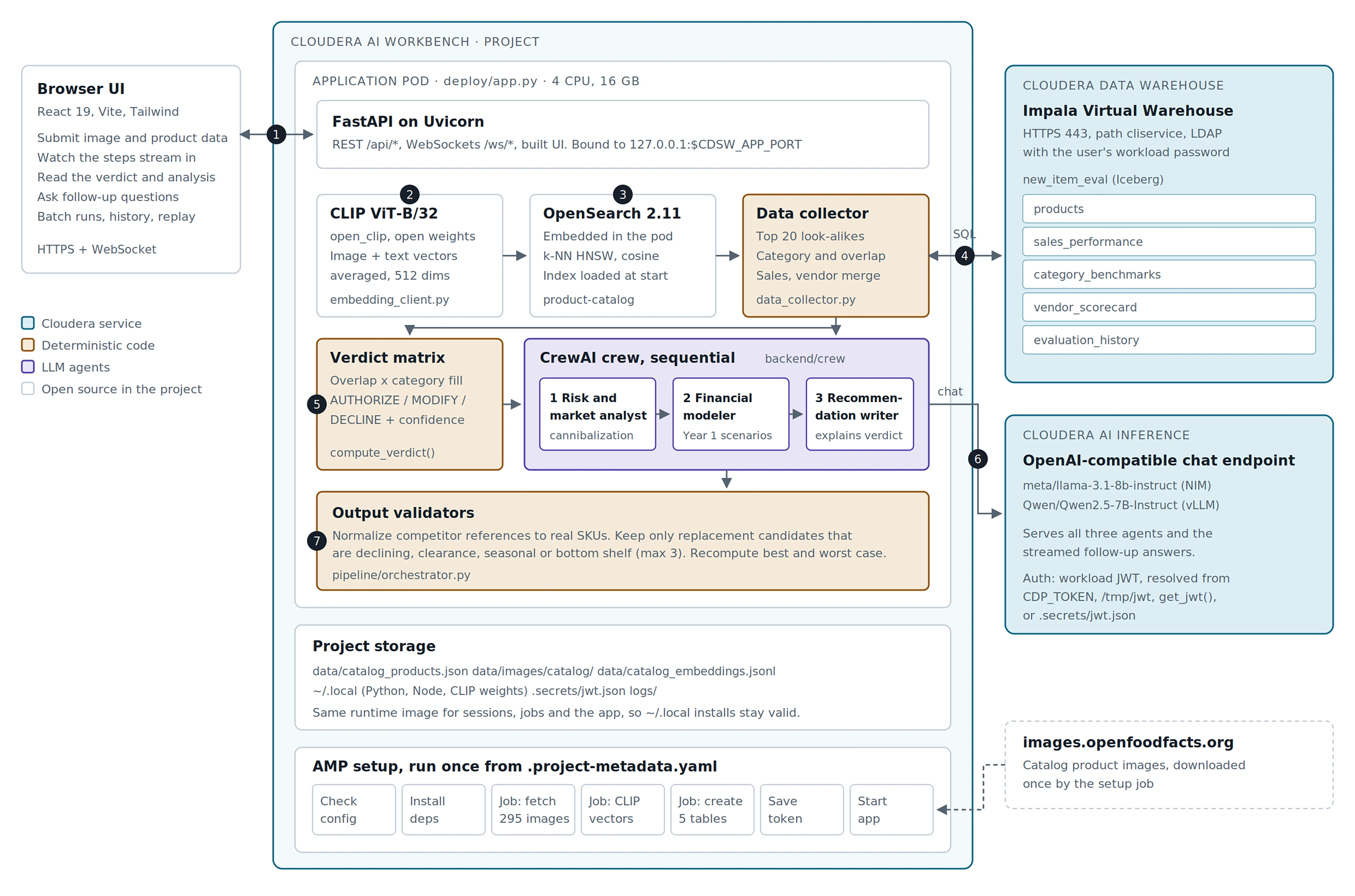
Reference architecture on Cloudera AI. The Application pod in the AI Workbench project runs the API and UI, CLIP and an embedded OpenSearch k-NN index. Sales, category and vendor data come from Iceberg tables through an Impala Virtual Warehouse in Cloudera Data Warehouse, and the three agents run on an open-weight model served by Cloudera AI Inference. Numbers 1 to 7 follow one evaluation: submit, embed, find look-alikes, query Impala, compute the verdict, run the agents, validate and save.
Your form submission has failed.
This may have been caused by one of the following:
- Your request timed out
- A plugin/browser extension blocked the submission. If you have an ad blocking plugin please disable it and close this message to reload the page.