
Every blueprint ships with source code, sample data, and step-by-step instructions — ready to run on your Cloudera Platform
-
Blueprint Card
Overview
Transform fragmented search into reusable knowledge base with Source Ledger on Cloudera.
Organizations spend significant time gathering information from websites, academic publications, and other external sources, but valuable research findings are often lost across individual searches, browser histories, and disconnected workflows. The Source Ledger Blueprint addresses this challenge by automatically capturing search results and organizing them into a consistent, queryable table that teams can revisit, share, and build upon.
By bringing together information from multiple search sources and preserving how each result was discovered, Source Ledger helps organizations eliminate repetitive search, improve collaboration, and establish a more reliable foundation for analytics and AI applications. Built for Cloudera, the Blueprint demonstrates how everyday information discovery can become a reusable organizational asset.
Business Value
Transform fragmented research into reusable organizational knowledge with Source Ledger on Cloudera, reducing duplicated research efforts, improving ergonomic productivity, and establishing a traceable tabular foundation.
Cost Savings - Reduce research costs by eliminating repetitive searches and duplicated information gathering; Improve search and data engineering productivity through centralized access to previously discovered sources; Accelerate research workflows by searching multiple information sources through a unified table; Lower data preparation costs by automatically organizing research results into reusable and structured records.
Cost Avoidance - Prevent loss of valuable research findings by preserving search history, query, results, and search hyperparameters; Minimize duplicated research efforts across teams and departments; Reduce operational risks associated with fragmented, inconsistent, or untraceable research processes; Avoid unnecessary integration and development costs through standardized access to multiple research sources.
Revenue Growth - Accelerate identification of market trends, competitive intelligence, and emerging business opportunities; Improve speed to insight by making research findings readily available for analysis and decision-making; Enable new AI-powered research and knowledge discovery applications using reusable source information.
Demo
The demo showcases how organizations can use Source Ledger on Cloudera to capture, organize, and reuse research findings.
See how a single research question can retrieve results from heterogeneous data sources. Rather than losing those findings after the search, Source Ledger automatically records the discovered links, original search question, and search settings in a consistent format.
The demonstration highlights how users can review previous searches, explore collected sources, and export findings for further analysis, illustrating how organizations can reduce duplicated research efforts and build a reusable foundation for collaborative research. Watch the demo
Key Features
Unified Research Discovery: Search across websites, encyclopedias, academic publications, and research databases through a single experience, reducing the need to navigate multiple platforms.
Reusable Research Knowledge: Automatically capture search results and preserve them for future use, transforming one-time research activities into lasting organizational resources.
Search History and Traceability: Maintain a record of each research question, its sources, and the search hyperparameters used, making findings easier to query for a further usage.
Cross-Source Discovery: Identify information appearing across multiple research sources, helping teams recognize supporting references and explore findings more thoroughly.
Searchable Research Repository: Organize research results into a consistent, searchable collection that teams can filter, compare, and reuse across projects.
AI-Ready Research Foundation: Prepare structured source information for downstream analytics and AI applications, including research assistants, knowledge discovery, and retrieval-based AI solutions.
Use Case
Research, competitive intelligence, and analytics teams frequently spend valuable time searching for information across disconnected sources, only to lose track of previous findings and repeat work already completed by others. The Source Ledger Blueprint addresses these challenges by automatically capturing research results from multiple external sources and organizing them into a consistent, queryable table that preserves the original search context. By transforming fragmented information discovery into reusable organizational knowledge, businesses can accelerate research, improve collaboration, reduce duplicated effort, and establish a stronger foundation for data-driven decision-making and AI-powered applications.
Architecture
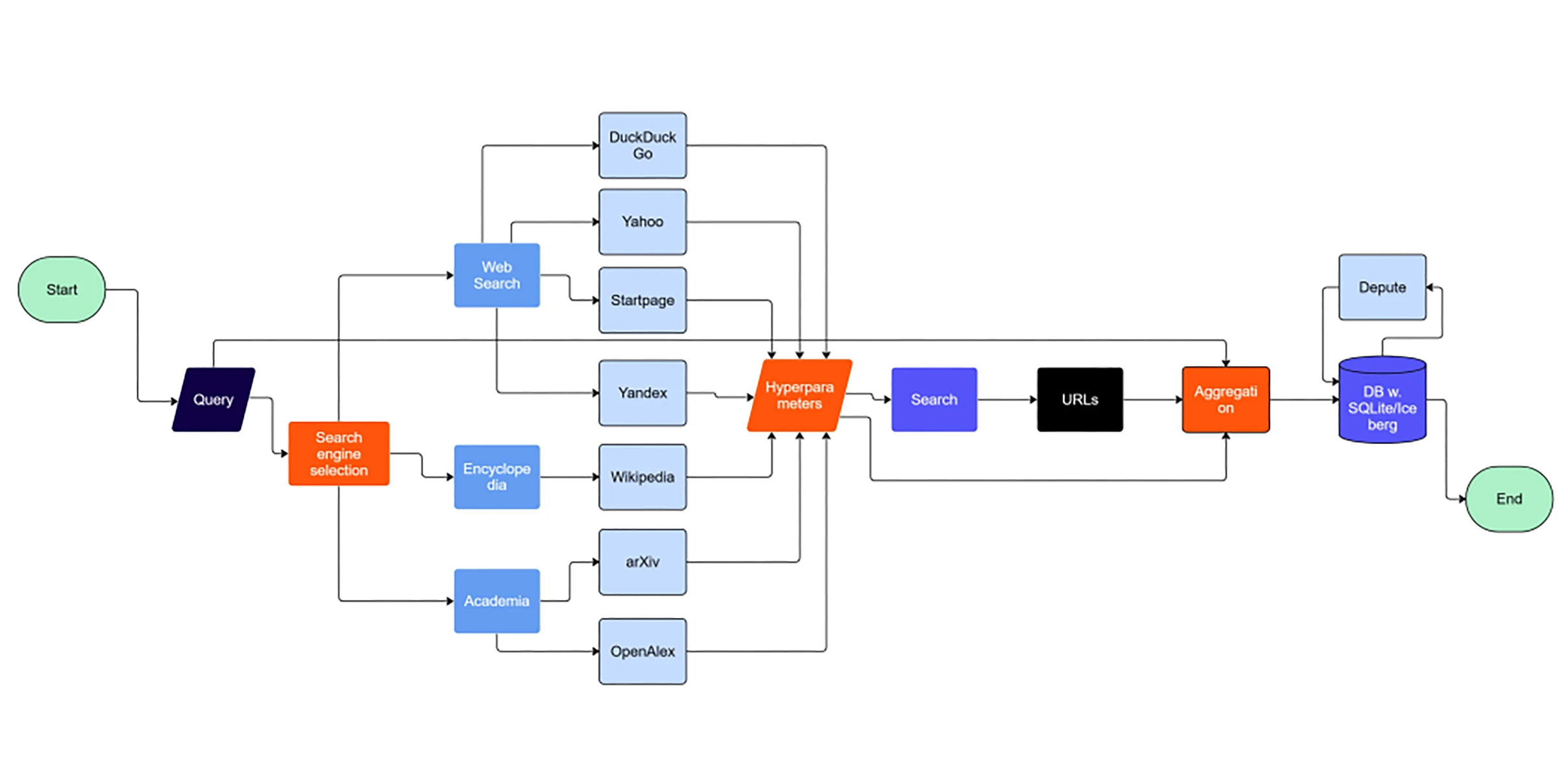
A query first passes through search engine selection, which routes it to one of three corpus types: web search (e.g., DuckDuckGo, Yahoo, Startpage, and Yandex queried in parallel), encyclopedia (e.g., Wikipedia), or academia (e.g., arXiv and OpenAlex). The selected engines run the search under the user's hyperparameters (e.g., region, safe search, time limit, result count), and the returned URLs are aggregated together with the original query and the parameters that were actually applied. Each aggregated result is written as a governed record to a relational database.
Your form submission has failed.
This may have been caused by one of the following:
- Your request timed out
- A plugin/browser extension blocked the submission. If you have an ad blocking plugin please disable it and close this message to reload the page.