
Every blueprint ships with source code, sample data, and step-by-step instructions — ready to run on your Cloudera Platform
Telecommunications
Unified Network Lakehouse for Analytics and AI
Unify fragmented network data into a trusted foundation, improving performance, reducing costs and accelerating analytics and AI.
-
Blueprint Card
Overview
Empower network operations with real-time intelligence and automated AI remediation on Cloudera.
Telecommunications and internet service providers manage increasingly complex networks spanning thousands of devices, locations, and customers. Disconnected monitoring systems and reactive troubleshooting make it difficult to identify emerging problems, prevent outages, and maintain consistent service quality.
The Network Lakehouse for Agentic Operations Blueprint brings network performance, operational telemetry, and AI-powered analysis together in a unified experience. By continuously monitoring network health, identifying abnormal conditions, and recommending or simulating corrective actions, organizations can accelerate incident resolution, optimize network performance, and improve customer experiences. Combined with intelligent capacity planning and operational dashboards, this approach helps network operators reduce manual effort, improve infrastructure efficiency, and transition toward more proactive, automated network operations.
Business Value:
Transform network operations with real-time intelligence and agentic AI on Cloudera, reducing service disruptions, accelerating incident resolution, and optimizing infrastructure investments through proactive monitoring, automated remediation, and predictive capacity planning.
Cost Savings - Reduce network operations costs through automated monitoring, troubleshooting, and incident remediation; Lower mean time to detect (MTTD) and resolve (MTTR) network issues through AI-powered root cause analysis; Improve network operations center (NOC) engineer productivity by reducing repetitive incident investigation and manual recovery tasks; Optimize infrastructure spending through intelligent capacity planning and efficient retention of network telemetry.
Cost Avoidance - Minimize costly network outages through proactive detection of service degradation and abnormal performance patterns; Reduce service level agreement (SLA) penalties and customer service disruptions through faster incident identification and resolution; Avoid unnecessary infrastructure investments by identifying capacity constraints and optimizing existing network resources; Reduce operational risks through automated remediation tracking and improved visibility into network health.
Revenue Growth - Improve customer retention through increased network reliability and consistent service quality; Protect recurring service revenue by minimizing outages and customer churn; Accelerate network expansion and new service delivery through predictive capacity planning; Support growth in subscribers and network coverage without proportional increases in operational staffing.
Demo
This interactive demonstration showcases how telecommunications and internet service providers can use Cloudera AI to monitor network performance, investigate service issues, and automate network operations.
Explore a simulated global network supporting approximately 1.8 million customers across 40 service areas, with interactive maps and operational dashboards displaying network health, performance trends, and active incidents. See how AI analyzes network anomalies, investigates potential root causes, and recommends corrective actions to help restore service more quickly.
The demonstration also highlights automated agile workflows, a digital twin for evaluating network capacity scenarios, and executive dashboards that connect network performance to service reliability and financial impact. Together, these capabilities illustrate how organizations can move from reactive troubleshooting to intelligent, proactive network operations. Watch the demo
Key Features
Unified Network Visibility: Monitor network health, infrastructure performance, and service conditions across thousands of network devices and locations through a centralized operational experience.
Real-Time Network Monitoring: Continuously track network performance indicators, identify emerging service issues, and detect abnormal conditions before they escalate into larger disruptions.
AI-Powered Root Cause Analysis: Accelerate troubleshooting with intelligent analysis that correlates network equipment, performance, and environmental factors to identify potential causes of service degradation.
Automated Network Remediation: Streamline incident response through AI-assisted recommendations and simulated self-healing actions, including traffic rerouting, load balancing, and equipment recovery.
Predictive Capacity Planning: Evaluate network growth, infrastructure utilization, and potential bottlenecks through digital twin simulations to support more informed investment and expansion decisions.
Intelligent Data Management: Organize and retain network performance information at different levels of detail to support operational analysis while limiting unnecessary storage growth.
Executive Operational Intelligence: Connect network performance, service reliability, customer impact, and financial indicators through dashboards that support business and infrastructure planning.
Scalable Network Operations: Demonstrate monitoring and analysis across thousands of network elements, providing a foundation for expanding AI-driven operations as network complexity grows.
Use Case
Telecommunications and internet service providers must maintain reliable connectivity across increasingly complex networks while managing rising operational costs, growing customer expectations, and the financial impact of service disruptions. Traditional network operations often depend on disconnected monitoring tools and manual troubleshooting, delaying incident resolution and making it difficult to anticipate emerging performance issues. The Network Lakehouse for Agentic Operations Blueprint addresses these challenges by combining unified network visibility, AI-powered anomaly analysis, automated remediation workflows, and predictive capacity planning on Cloudera. By transforming network performance data into actionable operational intelligence, organizations can reduce downtime, accelerate troubleshooting, optimize infrastructure investments, and improve customer satisfaction through more proactive and efficient network operations.
Architecture
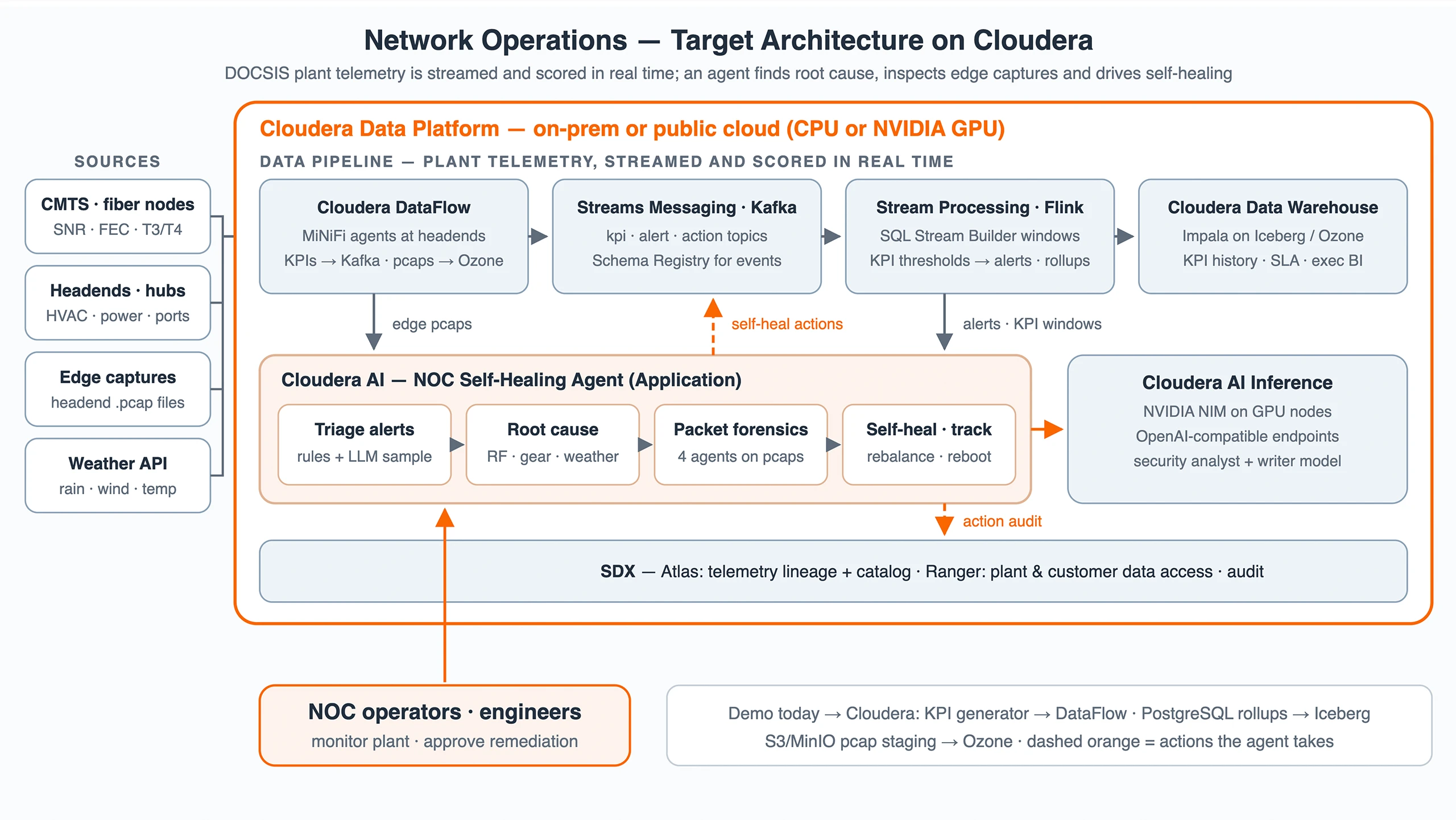
Powered by Cloudera Inference Service, AI Workbench, and Data in Motion for scalable network telemetry, analytics, and AI-driven operations.
Your form submission has failed.
This may have been caused by one of the following:
- Your request timed out
- A plugin/browser extension blocked the submission. If you have an ad blocking plugin please disable it and close this message to reload the page.