The definition of what makes AI successful is changing. Organizations are searching for real impact, not just a proof of concept. Today enterprise leaders need to understand whether they can connect the technology to the data, knowledge and business context needed to create that kind of result.
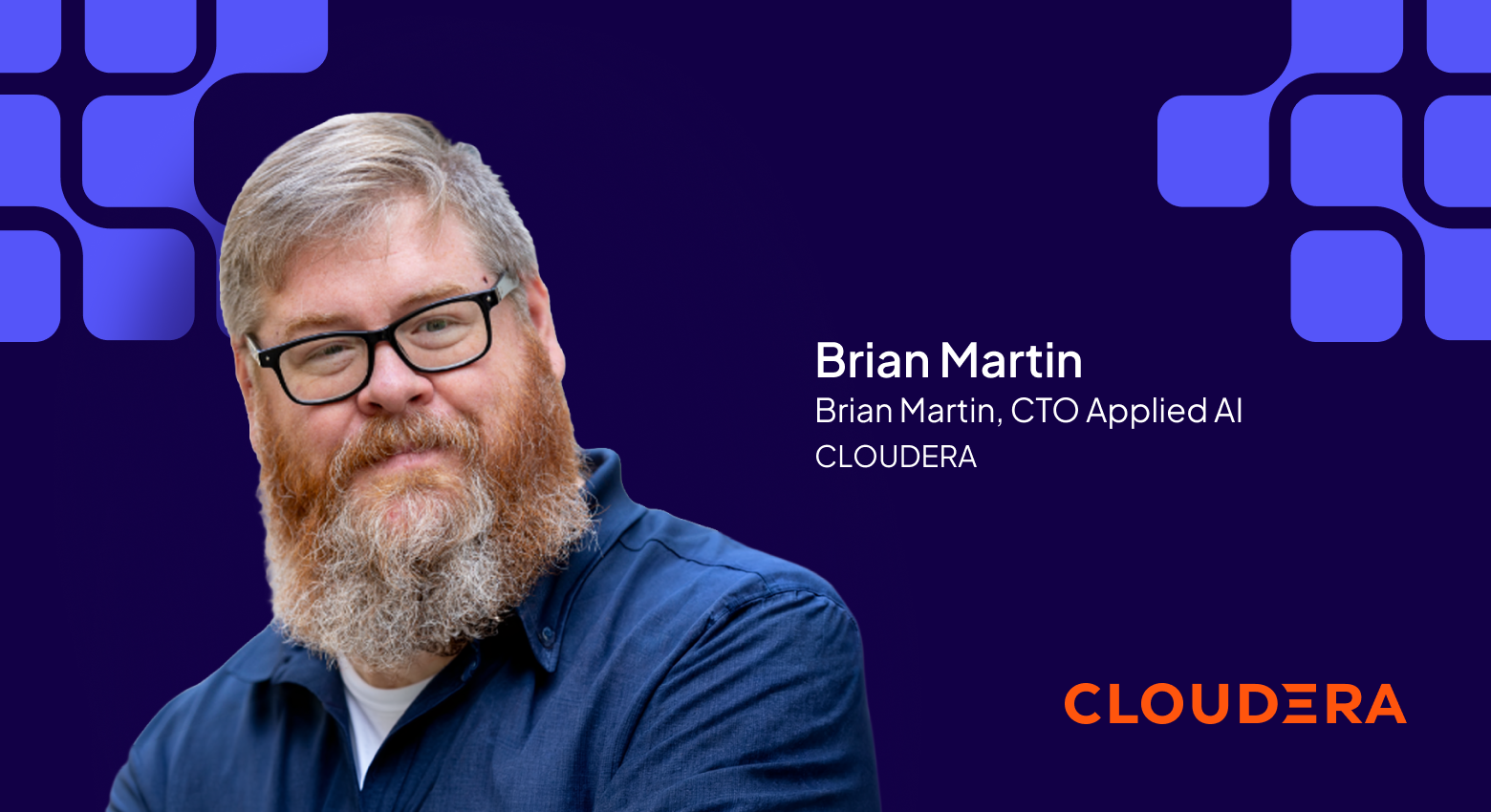
This is a challenge that Brian Martin, CTO of Applied AI and VP of Industry Solutions at Cloudera, is focused on helping customers solve. In his view, the path to enterprise AI success starts with understanding how organizations can move from data to information, knowledge, and insight—ultimately translating that into impact. It also requires recognizing that every customer is at a different point in that journey. Some need deeper guidance and expertise, while others already know where they want to go and need the right technology to help them get there.
Today, Brian and Cloudera’s Applied AI team work directly with customers to help them prove and deliver the value of AI in their own environments and on their own data, while also identifying approaches that could have broader impact over time.
As part of our blog series highlighting the people leading Applied AI, we sat down with Brian to hear about his journey from customer to Clouderan, what successful AI really looks like, and the approaches that teams should be taking to deliver real business value.
Centering Applied AI Through the Customer Perspective
Before stepping into his role as CTO of Applied AI, Brian was actually a Cloudera customer working with AbbVie. During that time, he had the opportunity to see firsthand what it takes to turn enterprise AI from an idea into something that delivers measurable outcomes.
In this role, Brian and his team were building a platform designed to bring together data from across R&D, normalize it, and build AI capabilities on top. When the team evaluated the technology needed to support that vision, Cloudera stood out for how quickly it could help them move from architecture to execution. “We decided the Cloudera platform gave us the fastest return on investment, and we could just do the most right then and there with that platform,” said Martin.
This customer-oriented framework shaped how Brian thinks about the work of Cloudera’s Applied AI team today.
Meeting Customers Where They Are
One of Brian’s biggest takeaways is that customers cannot all be treated the same. “There are a body of customers who need your help, and then there’s a body of customers who just need your stuff,” he said. “It’s really important to know which is which and who is who.”
Knowing the difference is key. If you go to a customer that is just looking for a solution and start telling them how it should be implemented, you risk driving them away. And if you bring new technologies to a customer that lacks the skills, resources, or knowledge to handle it, any implementation is going to be incomplete and unsustainable.
And this is what guides his approach to applied AI. You can’t bring the same playbook into every organization. Brian’s goal is to understand where a customer is, what capabilities they already have, and where Cloudera can create the most value.
That perspective is also what gives the Applied AI team an opportunity to identify patterns across engagements and industries. Approaches that prove successful with one customer can end up becoming reusable accelerators and, over time, potentially inform broader product capabilities that can benefit more organizations.
Extending Impact Beyond the Enterprise
Brian has always sought out opportunities to apply technology to all kinds of challenges that extend well past the enterprise world. In addition to his work at Cloudera, Brian is also the co-founder of Rare Hopes NFP, a nonprofit that grew out of his time with AbbVie.
While working with public scientific literature, Brian and his colleagues came to a realization—there was a huge amount of untapped knowledge that could be used to generate hypotheses for rare disease treatments, all using drugs that are already approved and on the market. The goal of Rare Hopes was to make these hypotheses – and the research behind them – accessible to doctors and researchers who could evaluate them further.
“We have this opportunity to make an impact for research, for healthcare, by making these hypotheses publicly available at no charge to doctors and researchers,” Martin said.
To Brian, it’s just one more example of what’s possible when data and technology are brought together with a clear purpose, and made available to the people who can act on it.
A Digital Career Grounded in a Passion for the Analog
It’s no secret that Cloudera is a highly distributed and global workforce. Since joining the company, one thing that has stood out to Brian was the willingness of people to connect, share, and learn from one another.
“People are really interested. They want to talk to you, they want to understand, they want to participate,” he said.
For all the time spent in the technology world, Brian makes an effort to spend as much of his free time as possible embracing the analog world. As an avid woodworker, he is currently making furniture and holiday gifts for friends and family. “It’s working with my hands, it’s making physical things instead of digital things,” said Martin.
He is also a devoted Scrabble player and reader of science fiction including contemporary works like Matt Dinniman’s Dungeon Crawler Carl, the Bobiverse series, and the works of Adrian Tchaikovsky - as well as classics like works from Asimov, Clarke, and Heinlein.
Learn more about two other members of Cloudera’s Applied AI group, Jake Bengtson and Laurence Da Luz.