Enterprise AI has reached an inflection point. Organizations are moving beyond isolated proofs of concept to production AI systems that continuously ingest, analyze, retrieve, and reason over enterprise data.
Building AI Factories requires more than powerful models and GPUs. It requires a unified data foundation that eliminates the complexity, duplication, and bottlenecks created by traditional architectures. With analytics, streaming, retrieval, inference, and agentic AI operating on shared enterprise data, AI Factories continuously transform data into intelligence.
The partnership between Cloudera and VAST Data addresses this challenge by modernizing two critical layers of the enterprise data platform. Cloudera and VAST Data bring together enterprise data and AI services with a unified data foundation for AI factories. Cloudera contributes data engineering, analytics, streaming, governance, and AI services, while the VAST AI Operating System provides integrated storage, database, and data-processing capabilities. The collaboration builds on the NVIDIA AI Data Platform reference design to help enterprises prepare and deliver AI-ready data for accelerated workloads.
A Unified Data Foundation for AI Factories
Most enterprise data environments evolved over decades. Data lakes, warehouses, transactional systems, object stores, and AI infrastructure frequently operate as independent silos connected through increasingly complex data pipelines.
While this architecture supports traditional analytics, it introduces unnecessary complexity for AI. Data is continuously copied, transformed, staged, and synchronized across multiple systems before it ever reaches an AI model.
The result is predictable:
Increased infrastructure costs
Duplicate data and governance challenges
Operational complexity
AI pipelines that spend more time moving data than using it
Rather than adding another layer of infrastructure, Cloudera and VAST simplify the underlying architecture. The joint architecture creates a unified data foundation where analytics, streaming, AI, and inference all operate against the same enterprise data rather than on disconnected copies.
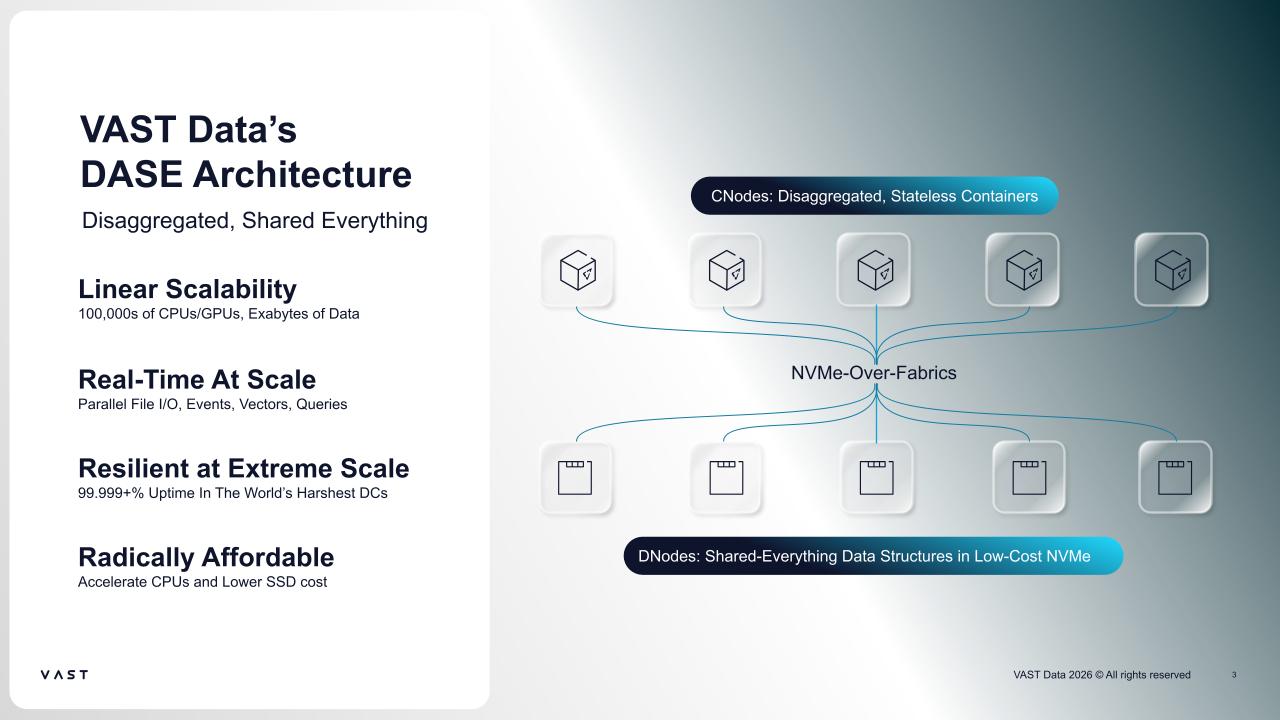
VAST's AI-native data platform provides a unified foundation for files, objects, tables, vectors, and event streams on a single high-performance storage platform. Its S3-compatible object storage enables Cloudera data services to operate directly against enterprise data without requiring data copies or architectural changes. Cloudera AI Inference, powered by NVIDIA NIM microservices, adds accelerated model serving, helping deploy and scale AI applications on this shared data foundation.
Independent Scaling for AI
Traditional shared-nothing architectures tightly couple compute and storage, forcing organizations to expand both together even when only one resource requires additional capacity.
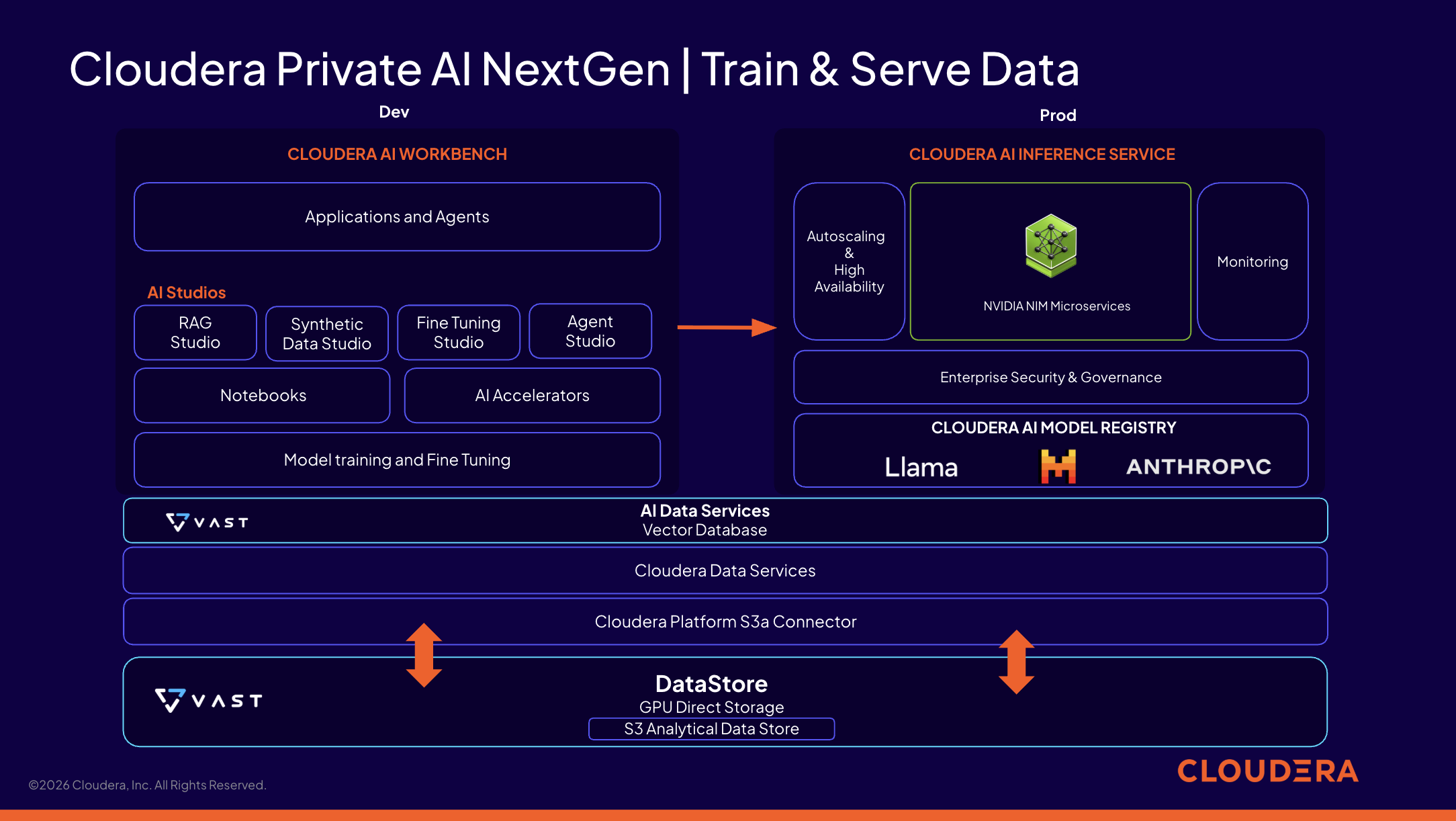
VAST's Disaggregated Shared-Everything (DASE) architecture removes this constraint.
Compute and storage scale independently while every compute node maintains direct access to shared data. This eliminates many of the storage bottlenecks, partitioning constraints, and east-west coordination traffic that limit performance in traditional distributed storage architectures. The result is infrastructure that scales predictably from analytics workloads to large-scale AI deployments without forcing organizations to overprovision storage or compute.
Building a Single Source of Truth
Enterprise AI performs best when models reason over complete, current enterprise information rather than isolated data copies. A unified data foundation is what enables AI Factories to continuously transform enterprise data into intelligence without repeatedly moving, copying, or synchronizing information across separate platforms.
By consolidating files, objects, tables, vectors, and event streams onto a shared storage foundation, organizations create a true single source of truth for both analytics and AI.
Instead of maintaining separate storage environments for data engineering, analytics, machine learning, and inference, Cloudera services access the same underlying data directly. This reduces ETL complexity, simplifies governance, and enables AI applications to reason over live enterprise data rather than stale replicas.
For retrieval-augmented generation (RAG) and agentic AI, this unified foundation becomes particularly valuable. Rather than building disconnected pipelines between storage systems, vector databases, and inference environments, organizations can support streaming ingestion, vector retrieval, and inference on one integrated platform.
Optimizing AI Infrastructure Efficiency
As organizations invest in accelerated infrastructure, the efficiency of the surrounding data architecture becomes increasingly important. Built with NVIDIA accelerated computing and AI software, Cloudera AI supports model development and inference that depend on timely access to enterprise data.
Modern AI workloads require sustained, high-bandwidth access to enterprise data for model training, inference, and real-time analytics. VAST provides the high-throughput, low-latency storage foundation needed to support these workloads, while technologies such as NVIDIA GPUDirect® Storage (GDS) can further optimize the data path by allowing compatible environments to transfer data directly between storage and GPU memory, bypassing traditional CPU memory copies.
The broader architectural advantage comes from DASE itself. By eliminating storage bottlenecks and enabling every compute node to access shared data in parallel, organizations improve utilization across expensive AI infrastructure while reducing delays caused by fragmented storage architectures.
Lower Cost Through Architectural Simplicity
Modernizing infrastructure is not simply about improving performance.
The Cloudera and VAST architecture also reduces total cost of ownership by eliminating unnecessary storage overhead, reducing infrastructure sprawl, and simplifying operations.
VAST combines advanced data reduction with low-overhead erasure coding to make large-scale, all-flash deployments economically viable while reducing rack space, power consumption, and operational complexity. Independent scaling of compute and storage allows organizations to grow AI capacity without continually refreshing both layers of the infrastructure.
The result is an architecture that improves both infrastructure efficiency and long-term economics.
Building AI Factories on a Unified Data Foundation
The partnership ultimately enables organizations to evolve beyond traditional data platforms into AI-native infrastructure.
Cloudera contributes enterprise-grade analytics, streaming, governance, machine learning, and AI services. VAST provides the unified, high-performance data platform that supports those services with scalable storage optimized for analytics and AI.
Together, Cloudera and VAST enable organizations to build AI Factories on a unified data foundation. Analytics, streaming, model development, retrieval, inference, and agentic AI all operate against the same enterprise data rather than disconnected storage systems and duplicated pipelines.
The result is a simpler architecture that reduces data movement, improves infrastructure efficiency, and accelerates the path from enterprise data to production AI. For organizations modernizing existing environments, the Cloudera and VAST partnership provides a practical path to an AI-native platform designed for today's analytics workloads and tomorrow's intelligent applications.
Learn how Cloudera and VAST can help you build and scale AI across hybrid environments.
Make sure to visit VAST at our upcoming EVOLVE26 events around the globe. Find out more.