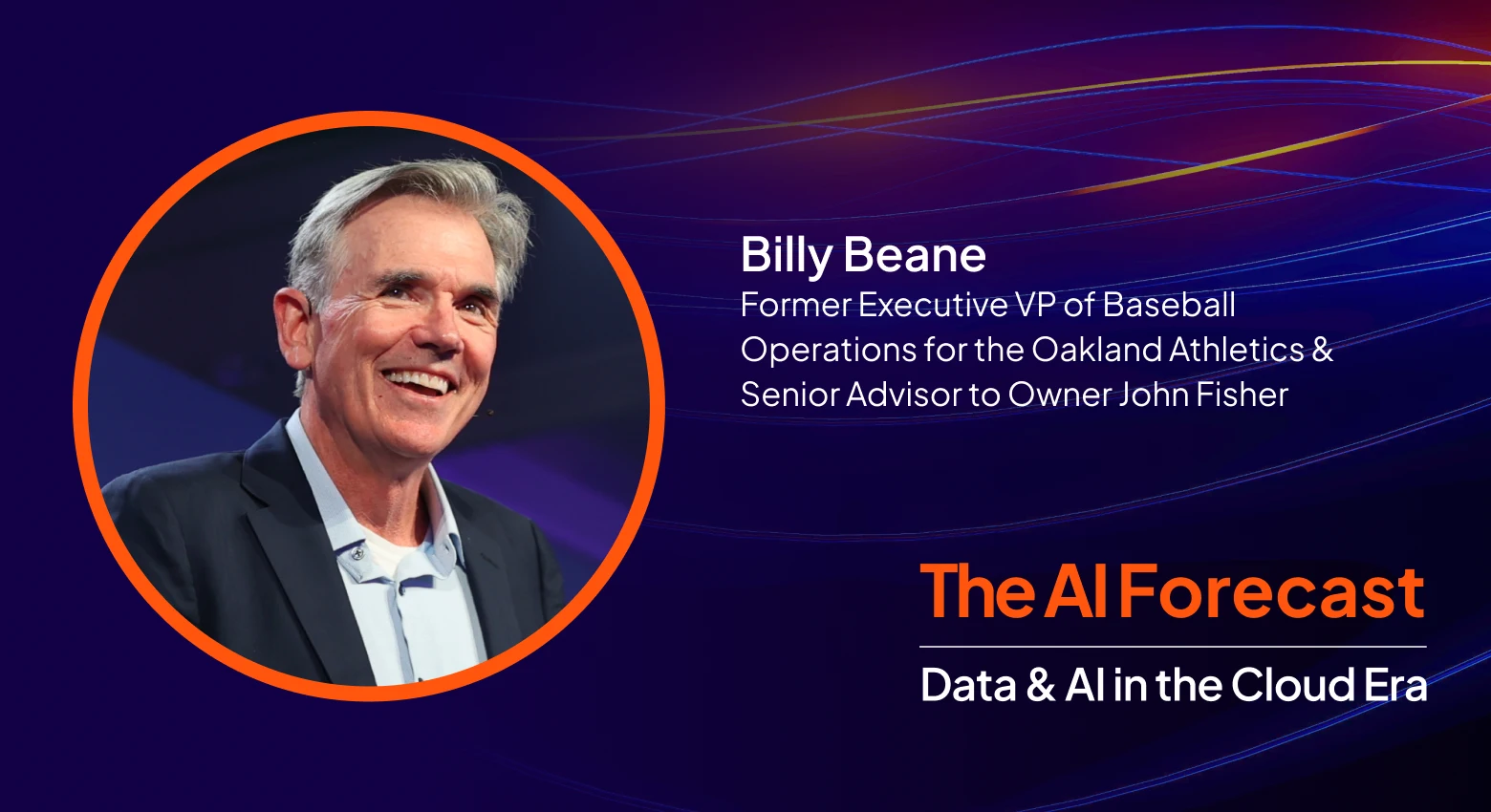
Baseball always ran on gut instinct and tradition… until Billy Beane proved the numbers could win.
In episode 62 of The AI Forecast, How Moneyball's Billy Beane Changed Baseball Forever with Data Analytics, Billy Beane joins host Paul Muller to discuss how evidence-based decisions challenged traditional baseball. He explains how constraints spur innovation, questioning assumptions is vital, and data helps organizations reinvent decision-making.
From evaluating talent to managing resources, Billy asserts that success depends on creating systems that prioritize evidence over ego. Below are a few of the main moments from Paul and Billy’s fascinating discussion.
Reframing Risk
Paul: How tough is it to navigate that point where you're confident in the idea, but the results aren't showing up quickly enough?
Billy: That’s a great question, and I leaned on my assistant. He used to say that if you're going to take a math test and someone is going to give you the answers, wouldn't you take them? We felt like using data was like that. They were giving you the answer to the test. Now, we wanted to leverage data and make a lot of decisions. We knew we weren't going to be right every single time; we weren't going to win every hand, but if we were disciplined with the data, ruthless with the numbers, and consistent in how we made decisions, over time, we would be correct.
I think there were a lot of assumptions when we were doing things that we were nervous about how this was going to turn out, but we felt the opposite, completely. We felt the use of data was kind of a roadmap and a fog light for us. And again, we weren't going to be right about every single decision, but if we were consistent with the way we made decisions over time, we would end up where we wanted to be, and it was going to be that discipline that was going to carry us through.
If you're right three times in a row, everybody's on board. Then the fourth time, if you're wrong, everybody says, ‘Oh, well, I told you that numbers don’t tell you the whole thing.’ And they sort of jump back to an emotional decision-making position, yet they don't hold emotional decisions to the same standard. One of the things we get complimented for, which I think is a little misguided, is that we were risk takers. We were actually completely the opposite. We wanted to manage risk, we wanted to be actuaries, and we thought what was risky was having information to help you make predictive decisions and not using that. That, to us, was the risk.
Data Over Orthodoxy
Paul: The good news is you got famous, and the bad news is you got famous. As other teams figured out what you're up to, how did you find a new edge? How did you stay scrappy?
Billy: I think the real revolution was when other teams started realizing the importance of data, collecting their own data, and using that data to build more predictive models. When we first started making decisions, we based them on statistics. Statistics are a result. What teams started figuring out was that there was a better way to measure process, which was a better predictor of skill, and that data collection was important. And quite frankly, it wasn't just about collecting data, but about bringing in some really, really bright, passionate people into our business who previously weren't working there.
The thing about the book Moneyball was that everything in that book was public information. We basically stole Bill James's ideas. The culture allowed us to do it because nobody really tried the ideas of Bill James or what he talked about in his pamphlets for years after that. Over the next 20 years, though, and as we sit here now, teams have become very private. They hire, and they have very large analytical staffs with bright young men and women helping them build these models using biometrics to improve player performance. It's gotten very, very sophisticated—far beyond even my understanding, to be totally frank.
Everyone’s a Data Person… Until It Disagrees With Them
Paul: In my experience, the challenge now is that you may be in a situation—particularly for really bright, experienced people—who will say, “I'm a data-driven person,” and they'll point to data, and they'll agree with it. But as soon as they come up with something that doesn't back up their experience, they may say, “Well, that data's not right, and I'm not going to use that data.” In short, cherry-picking the data is something that I've seen happen, and it goes back to the statement I made about everyone being a data person until it doesn't back up their opinion.
Billy: To me, that's the real opportunity. The experiences of a really successful long-term CEO in a business are data, and drawing on those experiences to help him make decisions is data. But I think in many cases, when you're with experienced people, we have a tendency to give in when they say, “Hey, that data’s not right.” Well, my response is usually that you don't get to disagree with the data, because it's not an opinion. It's a fact. In today's world, with all the data that we have exposure to, the real opportunity is when the data tells you one thing and your own experiences tell you something else. Personally, I prefer to always nod towards the data and ignore my own experiences when making decisions. And again, I know many people will disagree with that. To me, the opportunity is when really smart people see the same thing and the data tells them something, because you have to assume your competitor is going to see the same thing you do and make a decision along those lines.
Catch the full conversation with Billy Beane on The AI Forecast on Spotify, Apple Podcasts, and YouTube.