Cloudera Tutorials

Optimize your time with detailed tutorials that clearly explain the best way to deploy, use, and manage Cloudera products. Login or register below to access all Cloudera tutorials.

By registering or submitting your data, you acknowledge, understand, and agree to Cloudera's Terms and Conditions, including our Privacy Statement.
By checking this box, you consent to receive marketing and promotional communications about Cloudera’s products and services and/or related offerings from us, or sent on our behalf, in accordance with our Privacy Statement. You may withdraw your consent by using the unsubscribe or opt-out link in our communications.

ClouderaNOW Activate your data, unleash your AI, and scale across any cloud | Dec 9

Register
  • Cloudera Cloudera
  •  

    Introduction


    This tutorial will walk you through running a simple Apache Spark ETL job using Cloudera Data Engineering on Cloudera on cloud.


    Prerequisites


    • Have access to Cloudera on cloud with a data lake running.
    • Basic AWS CLI skills
    • Ensure proper Data Engineering role access
      • DEAdmin: enable Data Engineering and create virtual clusters
      • DEUser: access virtual cluster and run jobs


    Watch video


    The video below provides a brief overview of what is covered in this tutorial:


    Download assets


    Download and unzip tutorial files; remember location where you extracted the files.

    Using AWS CLI, copy file access-log.txt to your S3 bucket, s3a://<storage.location>/tutorial-data/data-engineering, where <storage.location> is your environment’s property value for storage.location.base. In this example, property storage.location.base has value s3a://usermarketing-cdp-demo, therefore the command will be:


    aws s3 cp access.log.txt s3://usermarketing-cdp-demo/tutorial-data/data-engineering/access-log.txt

     

    cmd-aws-upload


    Enable Cloudera Data Engineering


    If you don’t already have Cloudera Data Engineering service enabled for your environment, let’s enable one.

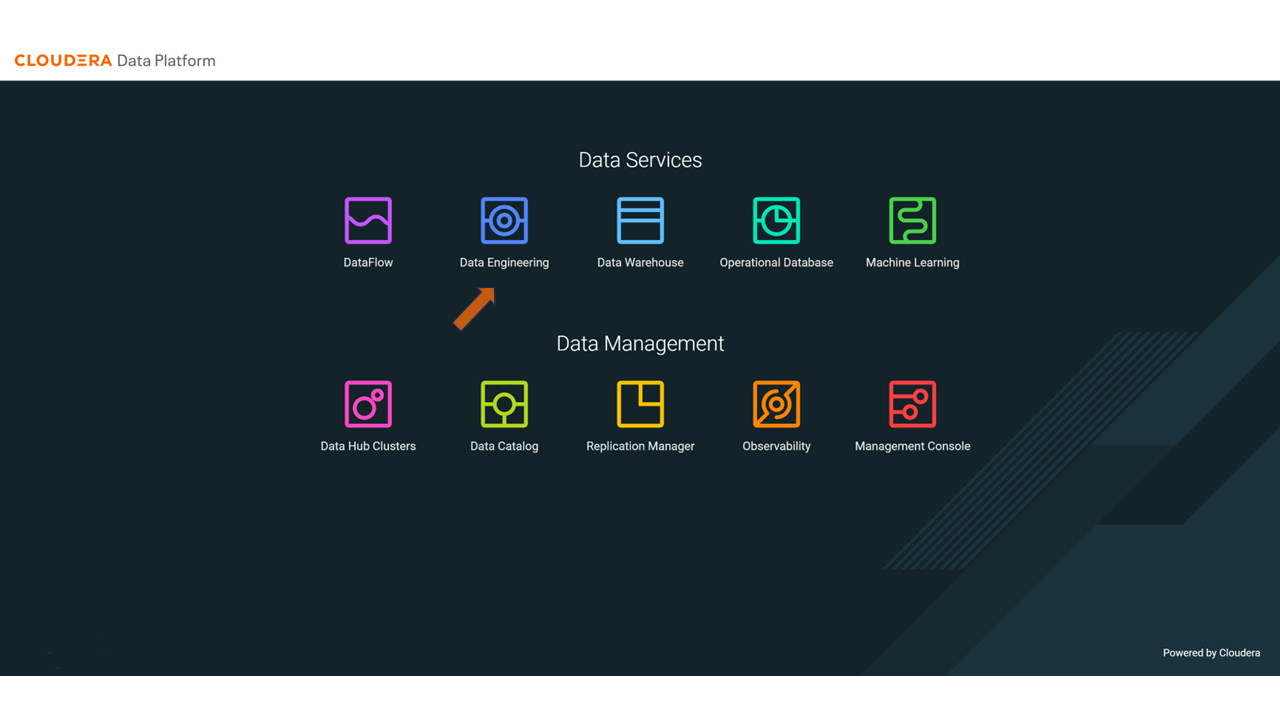
    Starting from the Cloudera Home Page, select Data Engineering:


    cdp-home-data-engineering


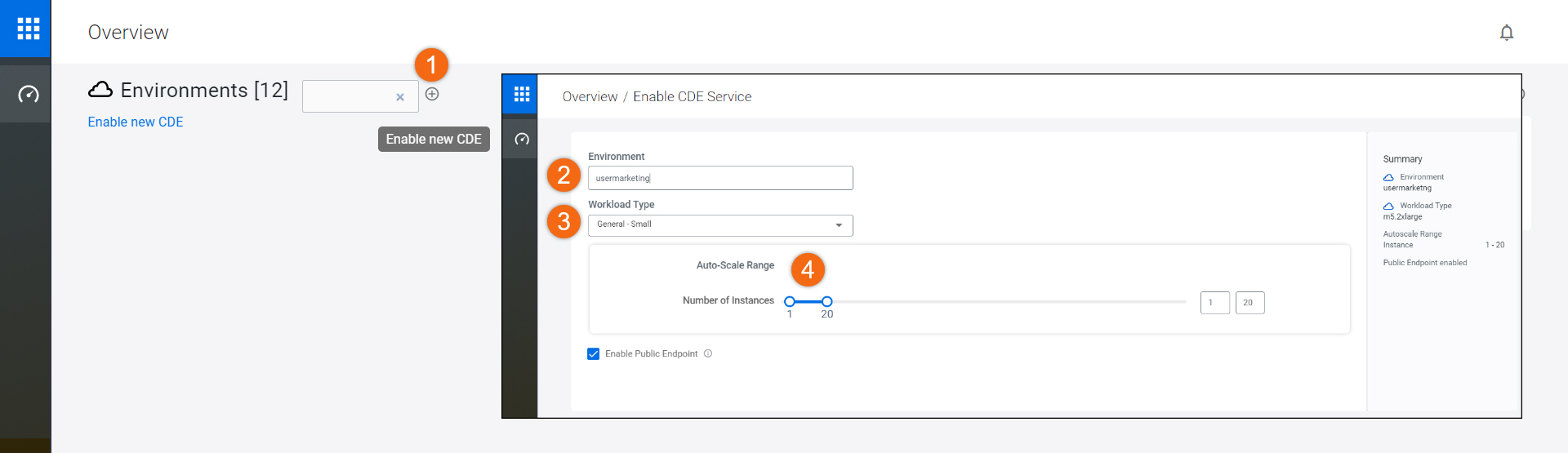
    1. Click on plus icon to enable new Cloudera Data Engineering
    2. Provide the environment name: usermarketing
    3. Workload Type: General - Small
    4. Set Auto-Scale Range: Min 1, Max 20


    cde-enable-service


    Create Data Engineering virtual cluster


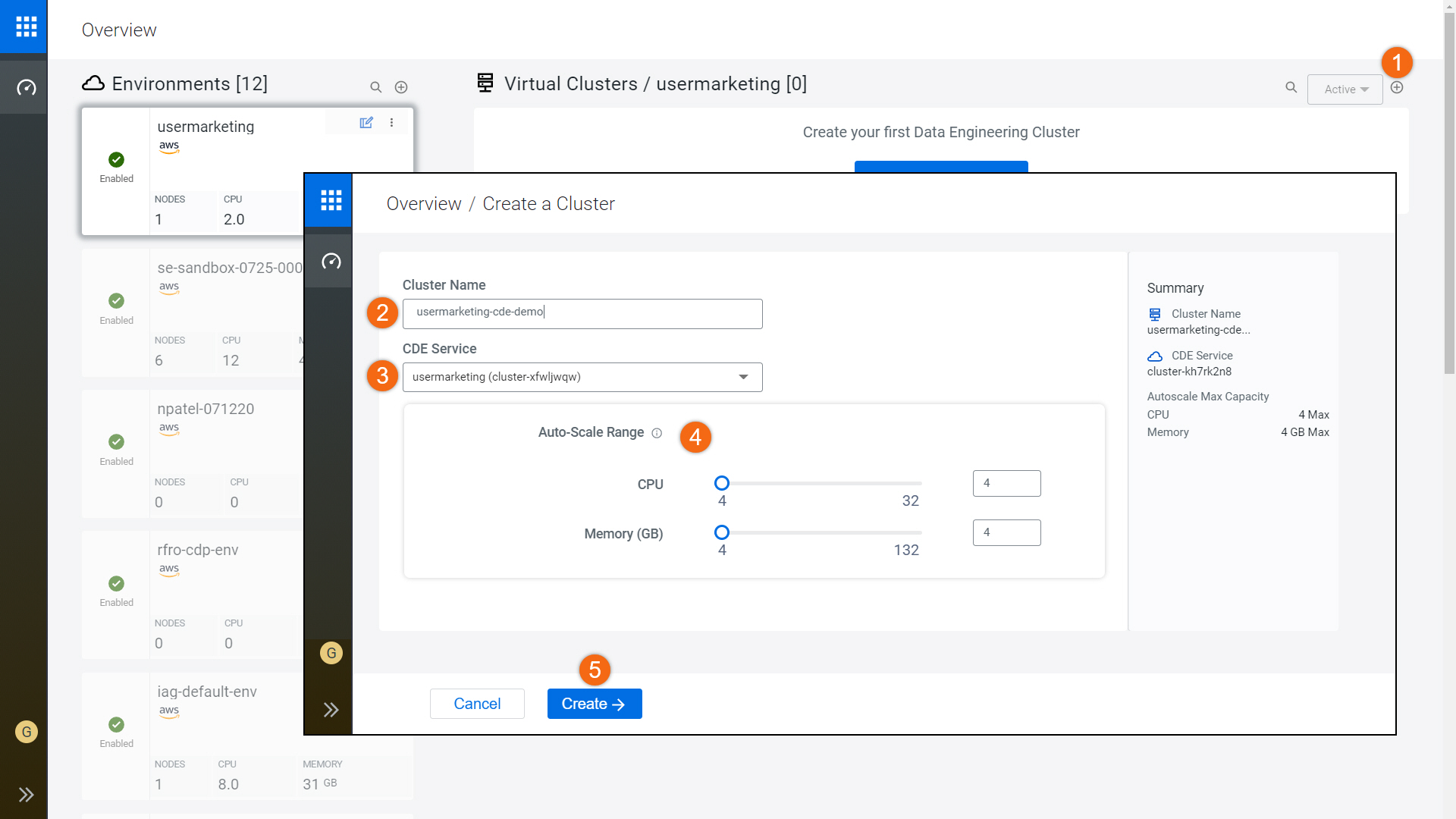
    1. Click on plus icon to create cluster
    2. Cluster name: usermarketing-cde-demo
    3. Data Engineering Service: usermarketing
    4. Auto-Scale Range: CPU Max 4, Memory Max 4 GB
    5. Create


    cde-create-cluster


    Create and schedule a job


    You can schedule a job to be run periodically or just run it once. We will take a look at both methods.

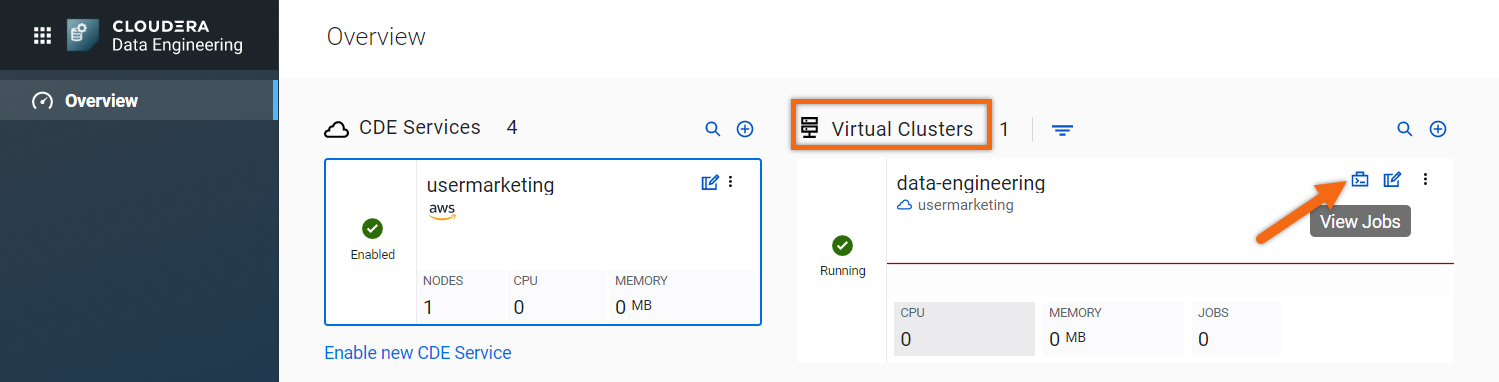
    Click on  for View Jobs.


    cde-view-jobs


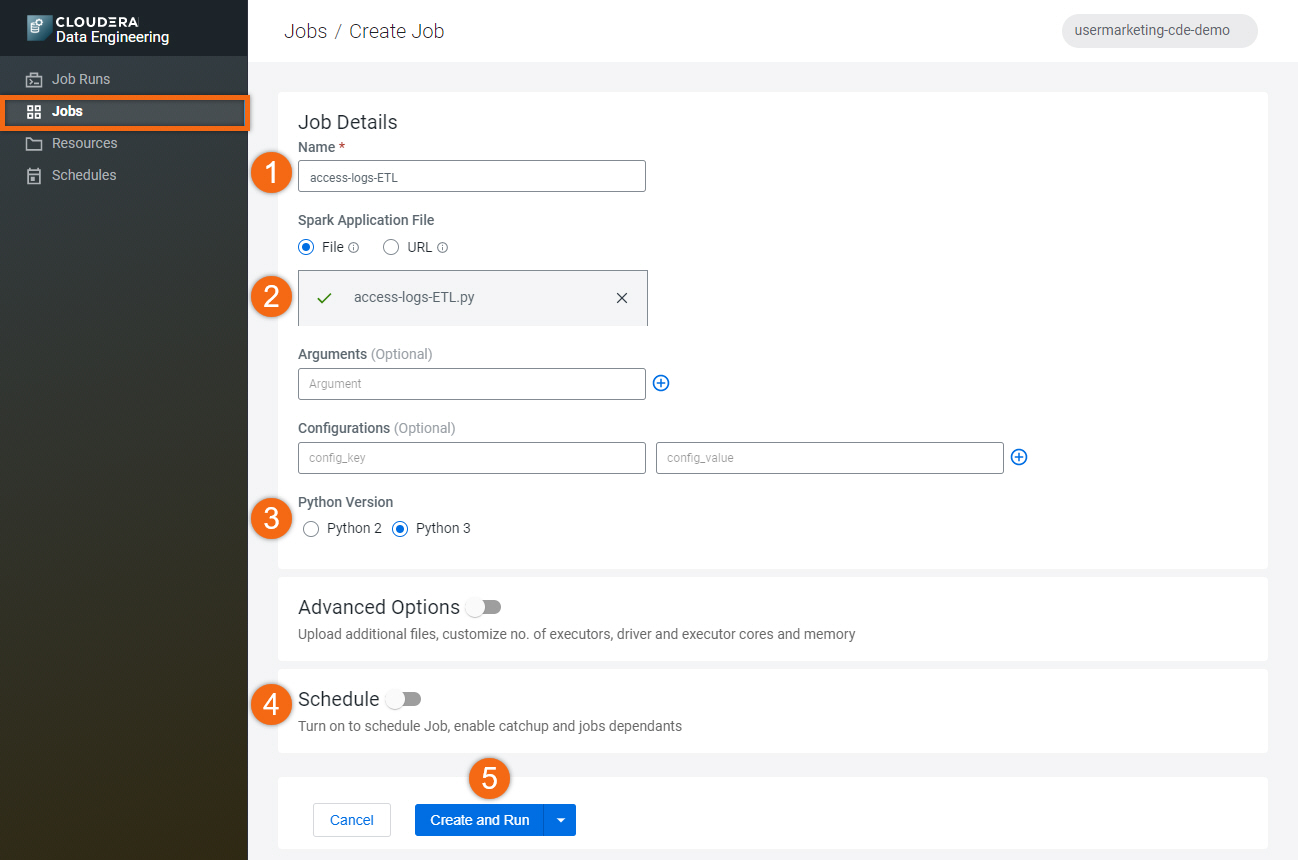
    In the Jobs section, select Create Job to create a job, access-logs-ETL - fill out job details:

    1. Name: access-logs-ETL
    2. Upload File: access-logs-ETL.py, from tutorial files provided
    3. Select Python 3
    4. Turn off Schedule
    5. Create and Run


    cde-jobs-create-job


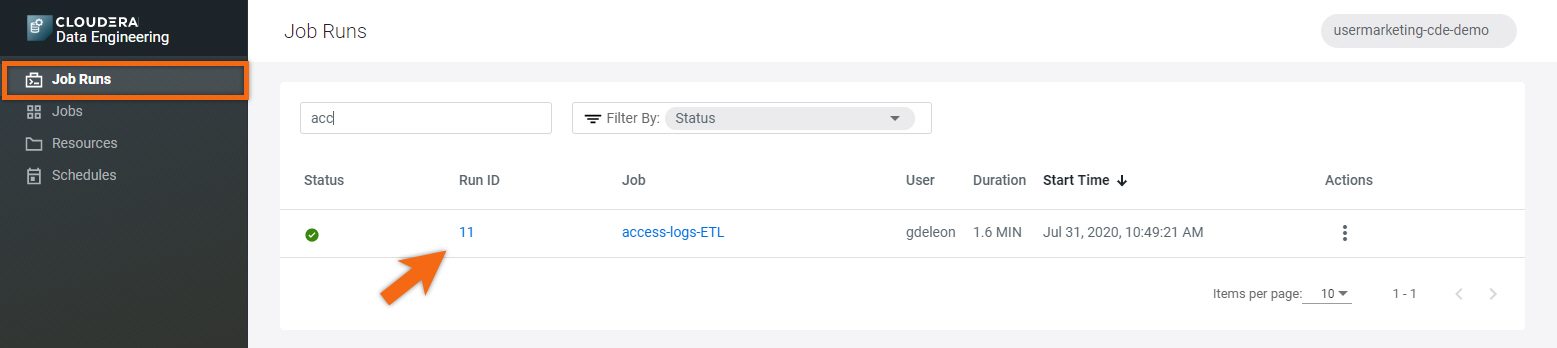
    Let’s take a look at the job output generated. In the Job Runs section, select the Run ID for the Job you are interested in. In this case, let’s select Run ID 11 associated with Job access-logs-ETL.
     

    cde-jobruns


    Let’s take a look at the job output. Here you can see all of the output from the Spark job that has just been run. You can see that this spark job prints some user-friendly segments of the data being processed so the data engineer can validate that the process is working correctly.

    Select Logs > stdout
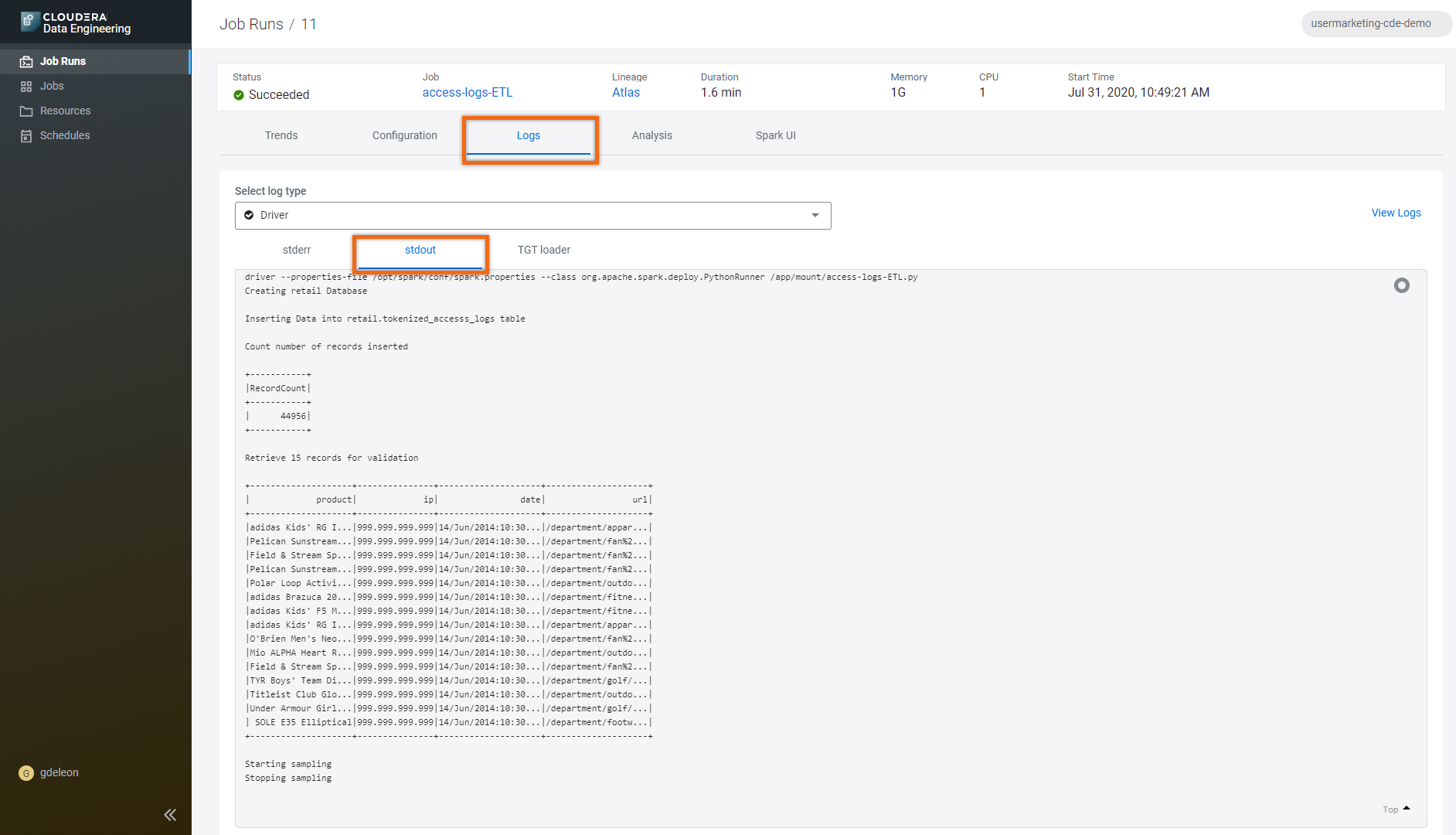
     

    cde-jobruns-stdout


    Let’s take a deeper look and see the different stages of the job. You can see that the Spark job has been split into multiple stages. You can zoom into each stage getting utilization details on each stage. These details will help the data engineer to validate the job is working correctly and utilizing the right amount of resources.

    You are encouraged to explore all the stages of the job.

    Select Analysis.
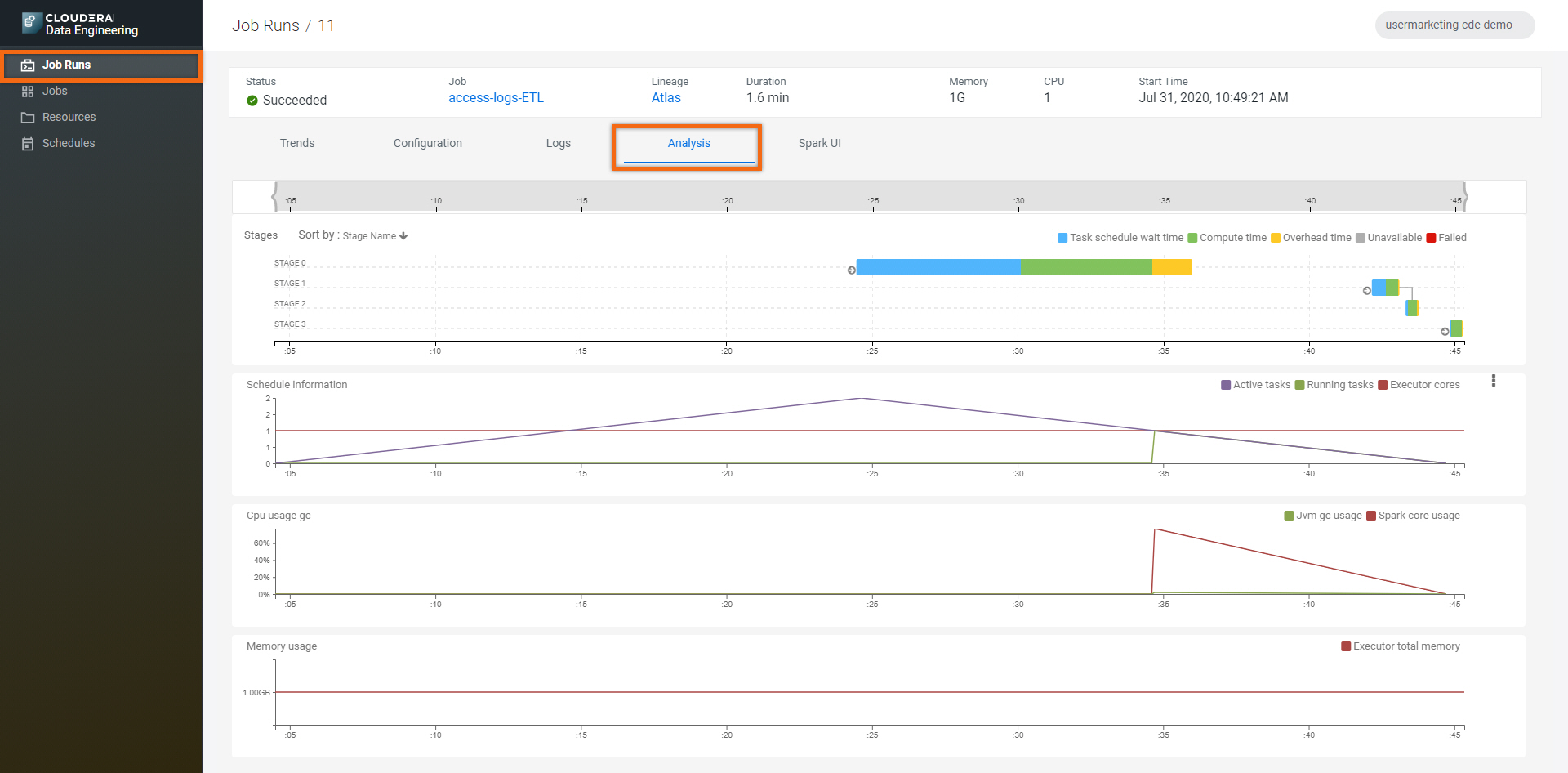
     

    cde-jobruns-analysis


    Once you are satisfied with the application and its output, we can schedule it to run periodically based on time interval.

    In the Jobs section, select three dots icon next to the job you’d like to schedule runs.

    Select Add Schedule.
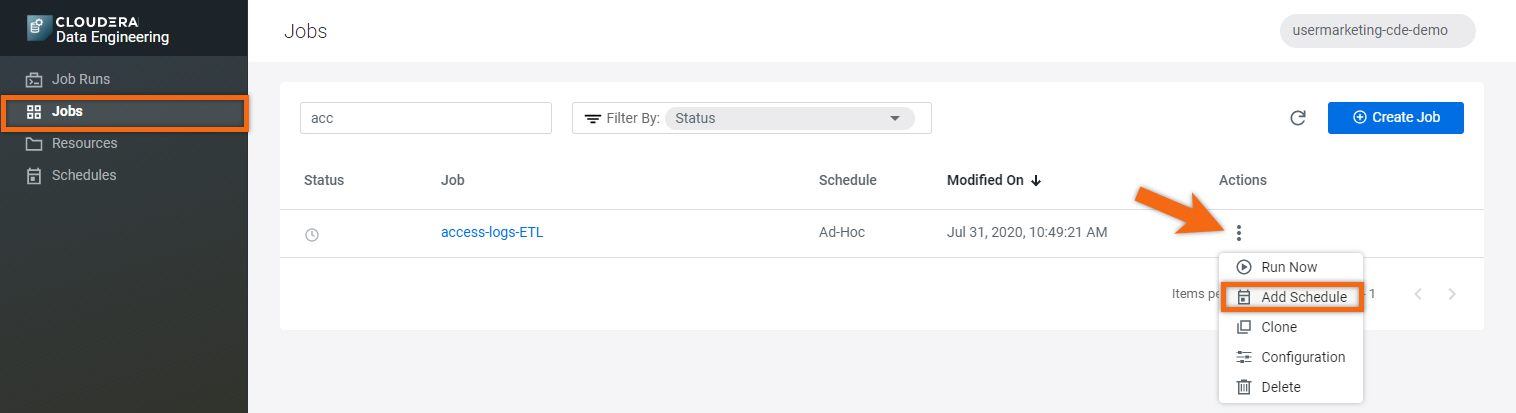
     

    cde-jobs-add-schedule


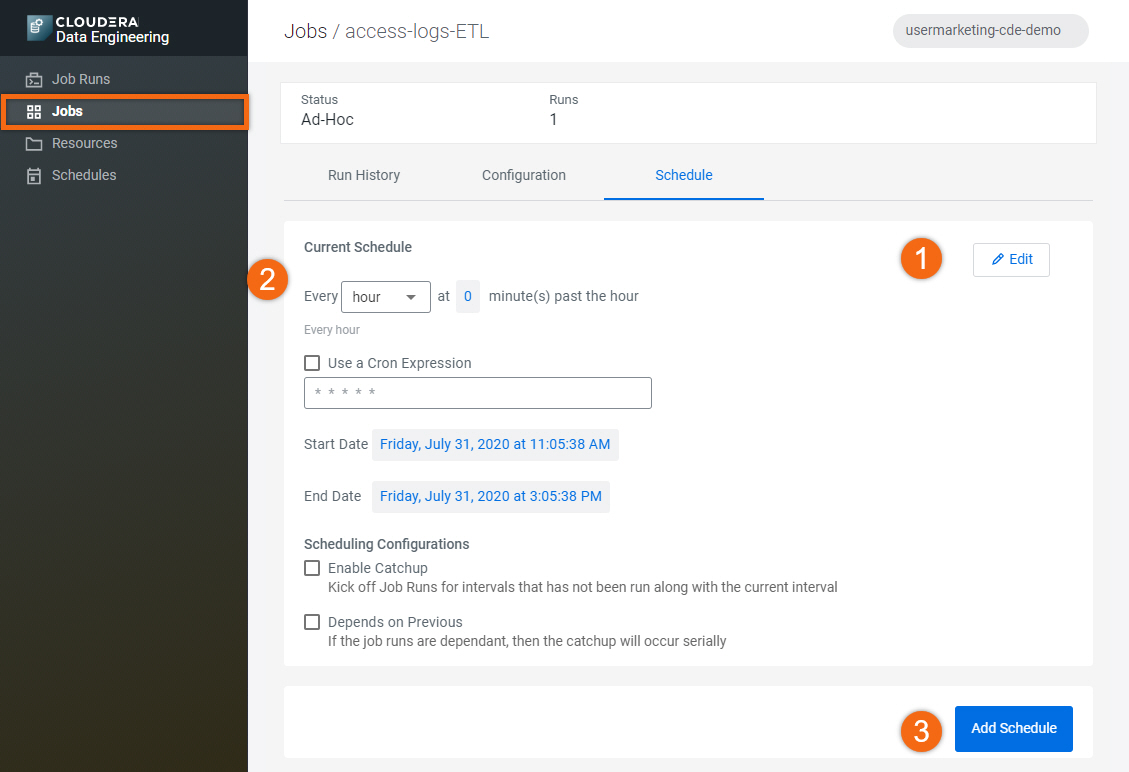
    1. Select Edit
    2. Set schedule: Every hour at 0 minute(s) past the hour 
    3. Add Schedule


    cde-jobs-accesslogs-add-schedule


    Summary


    Congratulations on completing the tutorial.

    As you've now experienced, Cloudera Data Engineering provides an easy way for developers to run workloads and to schedule them to run periodically.


    Further reading


    Ready to Get Started?

    Your form submission has failed.

    This may have been caused by one of the following:

    • Your request timed out
    • A plugin/browser extension blocked the submission. If you have an ad blocking plugin please disable it and close this message to reload the page.