
Life Sciences AI Needs Patterns, Not One‑Off Proofs Of Concept
Life sciences teams are working with more data, models, and regulatory scrutiny than ever before. And much of that data—omics, imaging, electronic health records, trial protocols, real‑world evidence, and more—is stored in unstructured formats that are hard to search and govern.
AI has the potential to redefine what’s possible in the life sciences—transforming vast, disconnected stores of biological and clinical data into actionable intelligence that accelerates discovery, sharpens decision making, and ultimately helps bring lifesaving innovations to patients faster. But first, organizations must prove that AI‑driven decisions are explainable, stable, and compliant.
In this environment, one‑off proofs of concept (POCs) are not enough. To achieve an acceptable level of governance and trust in AI-driven insights, life sciences organizations need to combine a trusted data and compute foundation with an intelligence layer that can orchestrate models and workflows at scale.
The Cloudera and Salt AI Partnership: A Reference Architecture for Contextual, Trusted AI at Scale
Cloudera and Salt AI are partnering to offer one powerful reference combination for life sciences teams.
Cloudera provides an open data lakehouse and enterprise AI platform that integrates data streaming, data engineering, data warehousing, and ML/GenAI at scale with a unified governance security and governance layer through SDX. This framework features attribute-based data access controls, lineage, and active metadata enrichment and cataloging.
Salt AI leverages those foundational security mechanisms and adds an orchestration layer across AI models and data. The scalable infrastructure continuously captures context—prompts, system prompts, workflow designs, run performance, user roles, and data sources—enabling complex use cases that capture full value from both specialized and general AI models. Tool calls for agentic operations can be readily spun up through Salt’s txt2 assistant, and pipelines come alive visually in the canvas, showcasing exactly how data flows.
This partnership enables life sciences organizations to apply fine-grained controls across on-premises, public cloud, and hybrid environments; use any model appropriate to a given task; and achieve an auditable, visual record of how AI systems make decisions.
In addition, both Cloudera and Salt AI drive computational and operational efficiencies across the data lifecycle. Leveraging GPU acceleration frameworks, Cloudera delivers improvements on data engineering and LLM inferencing workloads of up to 20x and 36x, respectively. Similarly, Salt AI offers optimizations such as a split-compute architecture that balances CPU and GPU processes, a sophisticated caching system, and the ability to swap, mix, and combine AI models into workflows. The more complex the pipeline and the more it is run, the greater the compute efficiencies when running on Salt.
Built to Live in a Broader Ecosystem
The Cloudera and Salt AI solution is explicitly designed to work seamlessly within each customer’s existing ecosystem of clouds, data platforms, and AI tools. It can be deployed in a customer’s virtual private cloud (VPC), with no public egress, and integrates with a diverse array of model providers, vector stores, and data systems.
Cloudera’s open data lakehouse, built on Apache Iceberg, offers a flexible and performant table format that combines multi-function analytics and automated data management capabilities (e.g., schema and partition evolution). This approach standardizes feature engineering workflows across disparate and diverse data sources, facilitating GxP compliance in life sciences.
Additionally, the Cloudera Iceberg REST catalog enables data sharing with other public cloud data platforms (e.g., Databricks, Snowflake) that support Apache Iceberg tables. Salt AI offers a mechanism that transforms text queries into R&D workflows that orchestrate LLMs, graph databases, modeling tools, and internal systems. Furthermore, it empowers researchers to convert code (e.g., Python scripts) into visual workflows, improving cross-functional collaboration among research teams. These capabilities accelerate innovation cycles by democratizing siloed research initiatives and automating the integration of complex systems without the labor-intensive effort to build custom integration and orchestration logic.
For organizations standardizing on Cloudera, this partnership offers a fast path: governed data combined with contextual orchestration, ready for use cases like molecule design, drug repurposing, translational medicine, protocol authoring, and medical affairs assistants. For others, it serves as a blueprint for marrying existing data platforms with a context‑first AI orchestration layer.
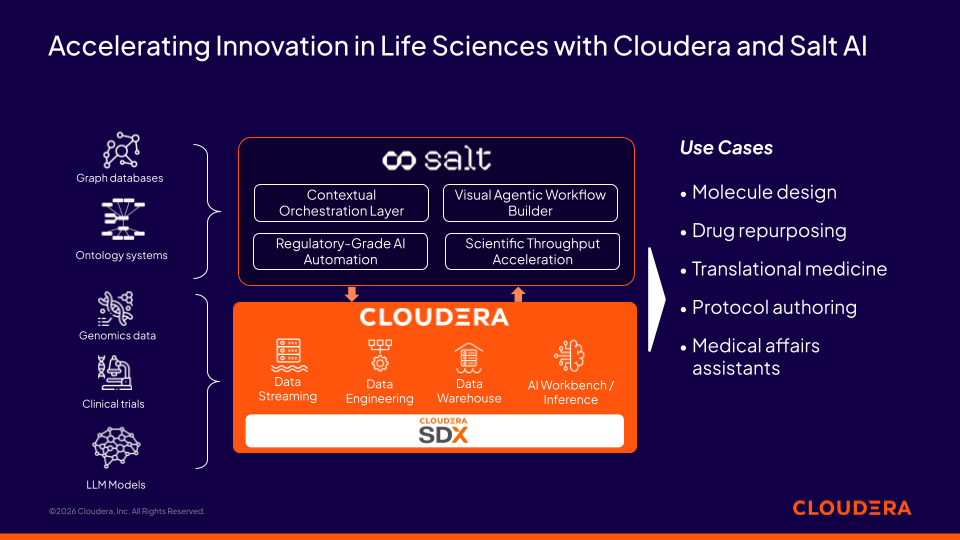
Figure 1. How The Cloudera and Salt AI Partnership Accelerates Innovation in Life Sciences
From Experiments to Business Value
In enterprise deployments, combinations of Cloudera and Salt AI have enabled organizations to achieve unprecedented scale, with a throughput of thousands of data engineering jobs per hour, faster prototyping of complex R&D workflows, and step‑change performance and cost improvements for machine learning workloads like AlphaFold2. For example, Salt AI has delivered processing times 22x faster than previous benchmarks for Alphafold2. Equally important, these gains come with full telemetry, governance inheritance, and a clear audit trail for every workflow run. Ultimately, teams can focus on scientific outcomes, and not on integration of existing data and technology solutions.
Salt AI will continue to invest in interoperability with a broad ecosystem of clouds, data platforms, and models while collaborating with partners like Cloudera to publish concrete patterns that regulated industries can adopt and adapt. For life sciences teams, that means more choices—and clearer examples—for turning AI experiments into durable, trustworthy systems. Learn more about Cloudera capabilities and the Salt AI platform.