
Spend enough time in the data management world, and you’ll quickly encounter a flood of terminology: semantic layers, knowledge graphs, unified metadata, governance fabrics, data meshes, and, of course, agentic AI. Most organizations know these aspects matter, yet many still struggle to understand how they fit together.
The problem with traditional data architecture is that it is often treated as purely technical. In reality, modern data management sits at the intersection of regulation, policy, operational risk, and engineering. Context across data flows is strictly required to ensure accountability. This is exactly why an AI-driven approach is no longer optional. It is the only way to scale.
A true data fabric is not just a platform that connects data sources. It is a layered framework for reconciling top-down business obligations with the bottom-up reality of enterprise data. As the recently named Leader in the 2025 Forrester Wave™ for Data Fabric Platforms, Cloudera approaches the data fabric architecture paradigm as a system of context, governance, and continuous alignment. At its core, the architecture connects regulations, policies, controls, and operational data into a single living ecosystem.
Let's take a look at the fundamental layers and approaches of the data fabric architecture that define boundaries and ownership.
The Top Layer: Establishing the Rules
Every governance strategy begins with understanding the rules that the business must follow.
Regulation
Regulations are the source of truth: laws, directives, and industry obligations that constantly evolve. The challenge is not simply storing them, but understanding what changed, when it changed, and which systems are affected.
Staying on top of constantly changing regulations was once (and for many still is) a highly manual task, an effort that ranged from incredibly difficult to practically impossible. Today, technologies like agentic AI make it possible to remain fully up to date. It can continuously ingest new legal guidance, detect updates at the clause level, and identify downstream impacts across the business. Crucially, humans stay in charge: Legal counsel remains responsible for determining exactly what applies and where.
Policy
Policies translate legal language into operational direction. They define who must do what, under which conditions, and create a shared interpretation across regulation, technology, and operations teams.
Without this layer, organizations often implement the same requirement differently across departments. [Agentic] AI can structure legal text into machine-readable rules while surfacing ambiguities for human review. Compliance teams ultimately own the interpretation and responsibility, and non-compliance cannot be explained by blaming the machines.
Standards
Standards, either self-defined or predetermined, turn policies into measurable controls. They define the evidence and testing required to prove regulatory adherence in practice.
This shifts governance from passive documentation to active verification. AI can continuously validate whether every policy has a corresponding measurable control and identify gaps before they become audit findings.
Risk and audit teams typically own this layer.
Where Rules Meet Reality
The most important layer is reconciliation: the point where business obligations connect to actual enterprise data.
Every regulatory requirement must map to something tangible, whether that is a customer record, consent flag, transaction history, or jurisdictional attribute. When that mapping fails, organizations uncover actionable gaps instead of silent non-compliance.
A context-aware data fabric continuously connects obligations to real operational data, allowing AI agents to surface mismatches immediately while humans remain accountable for governance decisions.
This layer is typically shared between risk leaders and enterprise architects.
The Bottom Layer: Defining the Data Estate
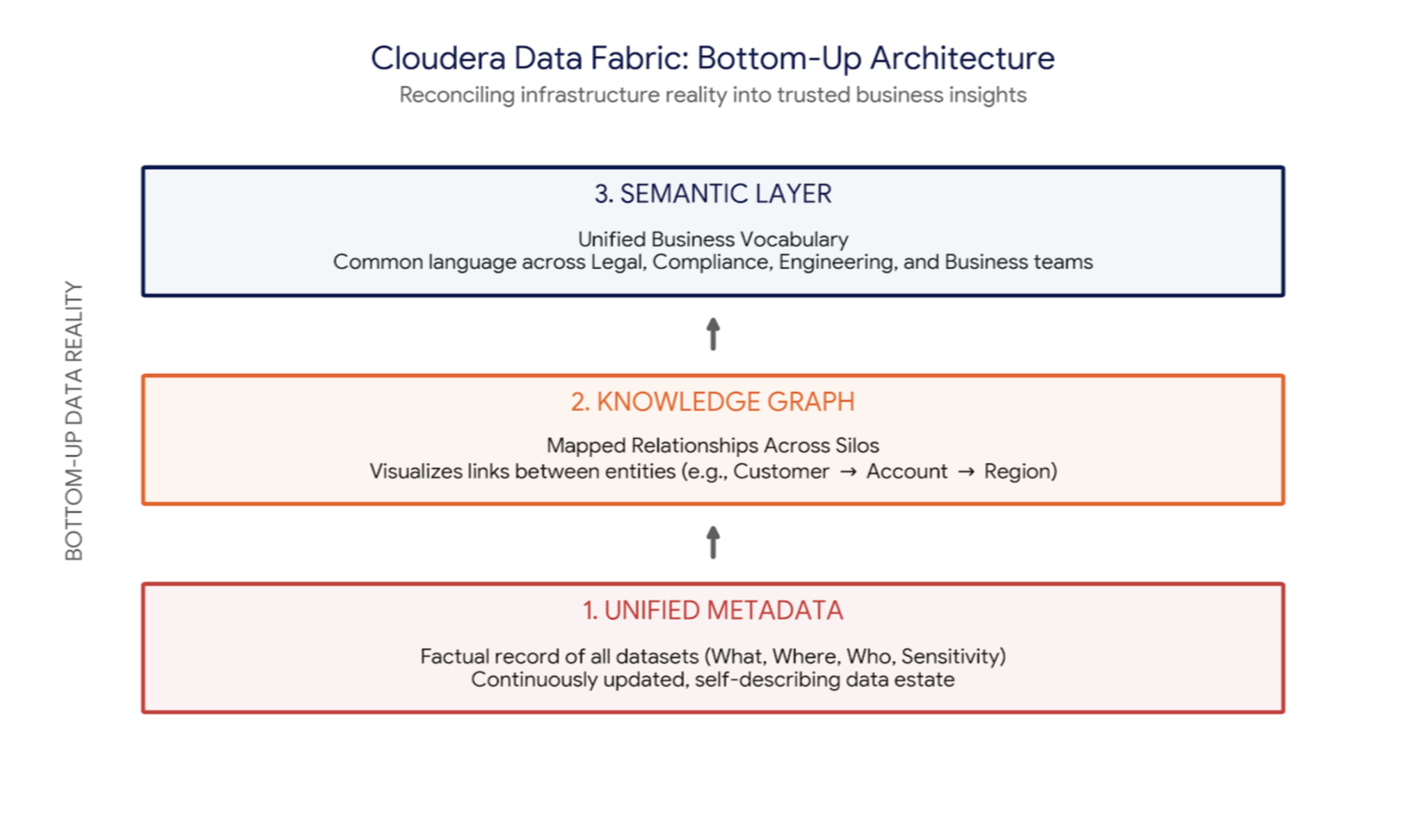
While the top-down layer defines obligations, the bottom-up layer defines reality.
Semantic Layer
The Semantic Layer is the shared vocabulary of your business, creating unified definitions for concepts like "customer" or "consent" so that legal, compliance, architecture, and engineering teams all speak the exact same language. In telecommunications, for instance, a "customer" might be an account number to billing, an active SIM card to network engineers, or an entire household to marketing. The semantic layer harmonizes these disparate views into a single, universally understood framework. Owned by Data Architecture, this layer ensures teams stop arguing about definitions because AI-assisted modeling builds the vocabulary directly from the actual structure of their data, rather than relying on outdated documentation or whiteboard drawings.
Knowledge Graph
If the semantic layer defines concepts, the knowledge graph defines relationships.
It maps how entities connect across the organization: customers to accounts, products to regions, and regions to regulations. In distributed environments, this relationship mapping becomes essential for understanding context across silos.
AI agents help maintain these connections as systems evolve, while domain stewards validate meaning and resolve disputes.
Unified Metadata
Unified metadata is the living inventory of the data estate. It describes what data sets exist, where they originated, who owns them, and how sensitive they are.
In a modern data fabric, metadata becomes dynamic rather than manually maintained. AI continuously monitors systems for drift, anomalies, and classification changes before they become governance problems.
Platform engineering teams typically own this foundation.
Unification Without Consolidation
One of the biggest misconceptions about enterprise governance is that everything must be centralized into a single repository or cloud platform.
True data fabric architecture works differently. It focuses on unification, not consolidation.
The goal is to connect distributed systems while preserving ownership, accountability, and context. Policies remain linked to operational data regardless of where that data resides. AI agents assist with detection, mapping, and enforcement, but humans continue to own interpretation and governance decisions.
Organizations that succeed with data fabric architecture are not the ones with the fewest systems. They are the ones that can continuously align regulations, business meaning, and operational data into a governed framework that evolves as quickly as the business itself.
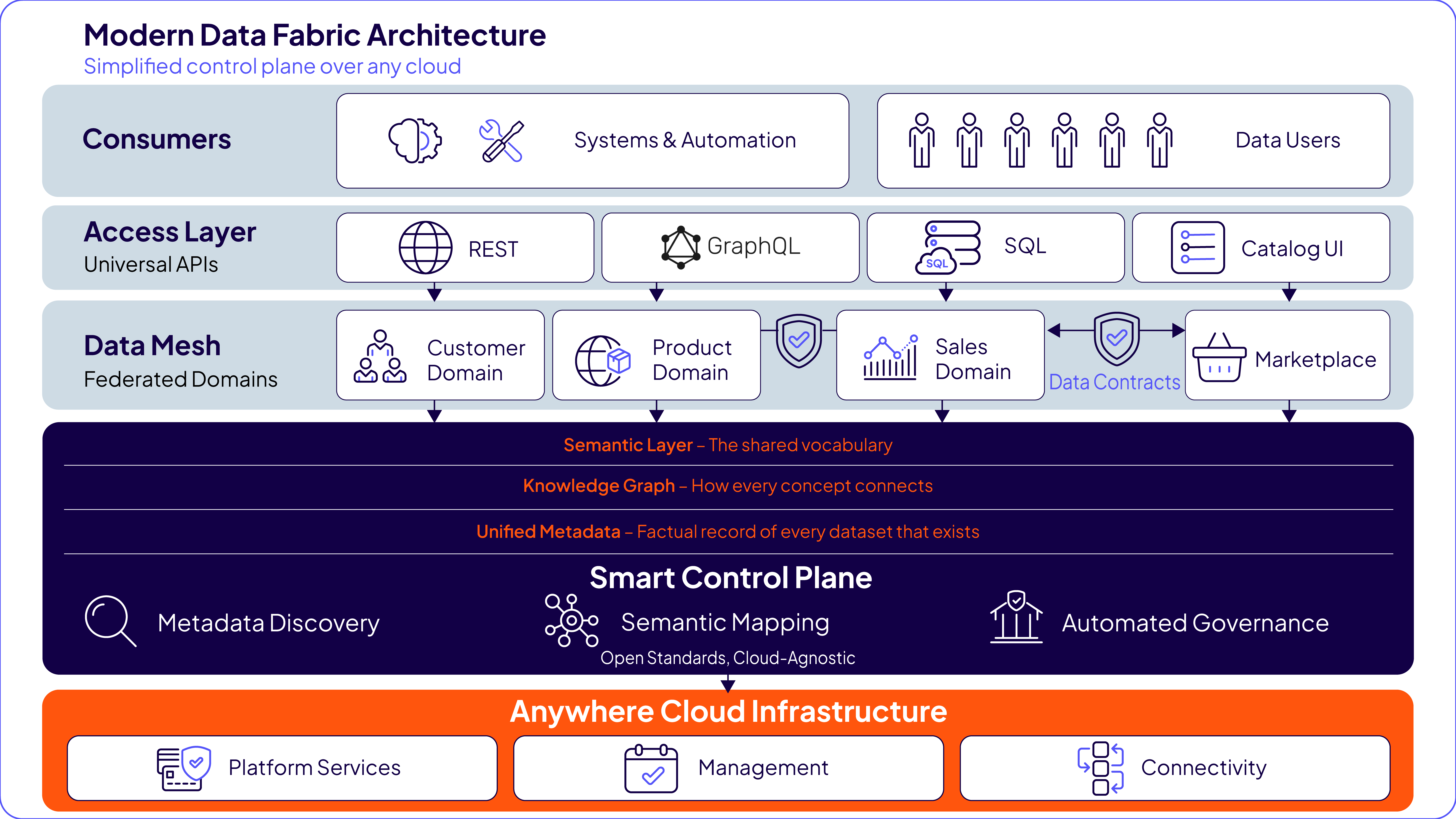
Cloudera delivers this unified control and visibility across all of your infrastructures. This true hybrid support extends far beyond just the data fabric; it is a foundational thread throughout our entire platform. While most organizations and vendors merely acknowledge the reality of heterogeneous infrastructure, only Cloudera fully builds a platform around this reality. Rather than forcing you to migrate and consolidate into a single cloud environment or pay the lock-in tax, we unify your entire data estate.
Discover how Cloudera's Unified Data Fabric unifies your data anywhere without forcing you to consolidate it—visit cloudera.com to read the full report and unlock your data's potential today.