
Enterprises are moving aggressively to deploy highly valuable, differentiated AI agents into production. But the most valuable agents depend on the data organizations can least afford to lose control of: sensitive, proprietary data.
That creates an immediate governance challenge. In many traditional architectures, agents must move data out of managed storage and into external SaaS platforms before they can use it. The moment that happens, organizations lose the ability to govern the data entirely at its source and inherit three compounding risks:
Security: Every export creates an external copy of sensitive data, expanding the attack surface and forcing teams to govern, patch, and audit a parallel dataset separately from their source of truth.
Performance: Round-tripping data to an external platform introduces latency and strips away the query optimizations built into managed storage, causing agents to run far slower than the underlying infrastructure allows.
Cost: Extracting data across cloud perimeters at scale drives up egress fees—often unpredictably, since agent workloads query data repeatedly rather than just once.
The data and AI we need for truly differentiated value are often the ones that carry the highest risk if they leave our control. As a result, compliance and security teams evaluating these exact risks are frequently forced to step in, halting promising initiatives just as they clear the proof-of-concept phase.
The Five Structural Barriers to Production AI
At their core, agentic workflows—which combine reasoning LLMs with tool interfaces, structured task planning, and continuous execution loops—cannot operate safely on isolated infrastructure. They require direct access to compute resources for managed data foundations. When forced into fragmented, data-moving setups, organizations encounter five distinct roadblocks:
Black-Box Autonomy and Audit Liabilities: Autonomous multi-step decisions create regulatory risks. Standard system logging captures endpoint calls but misses internal sub-agent task planning, specific tool payload inputs and outputs, and the authenticated user identity behind each step.
Governance Drift Across Siloed Teams: When business teams construct visual prototypes in unmonitored SaaS tools while engineers write custom Python orchestration scripts in separate environments, technical architecture splits. This duality bypasses central access controls and causes governance drift.
Fragile Prompting and Execution Retries: Traditional agent frameworks instruct models through unstructured text prompts. When an LLM outputs free-form text instead of structured payload schemas, execution chains break. System retries consume extra API tokens, raise query latency, and cause failures across multi-step execution paths.
Cloud Egress Fees and Token Inflation: Extracting operational datasets across cloud perimeters to external hosts generates recurring data egress fees. Passing unstructured, uncurated context into external LLM context windows increases token usage on every query, driving up inference cost per query without improving reasoning accuracy.
API Lock-In and Fixed Compute Costs: Hard-coding orchestration logic to proprietary model APIs locks enterprises into fixed compute pricing. Infrastructure teams lose the flexibility to route routine function calls to lower-cost local parameter models while reserving third-party frontier APIs for complex reasoning.
How Cloudera Agent Studio Delivers Governed Execution
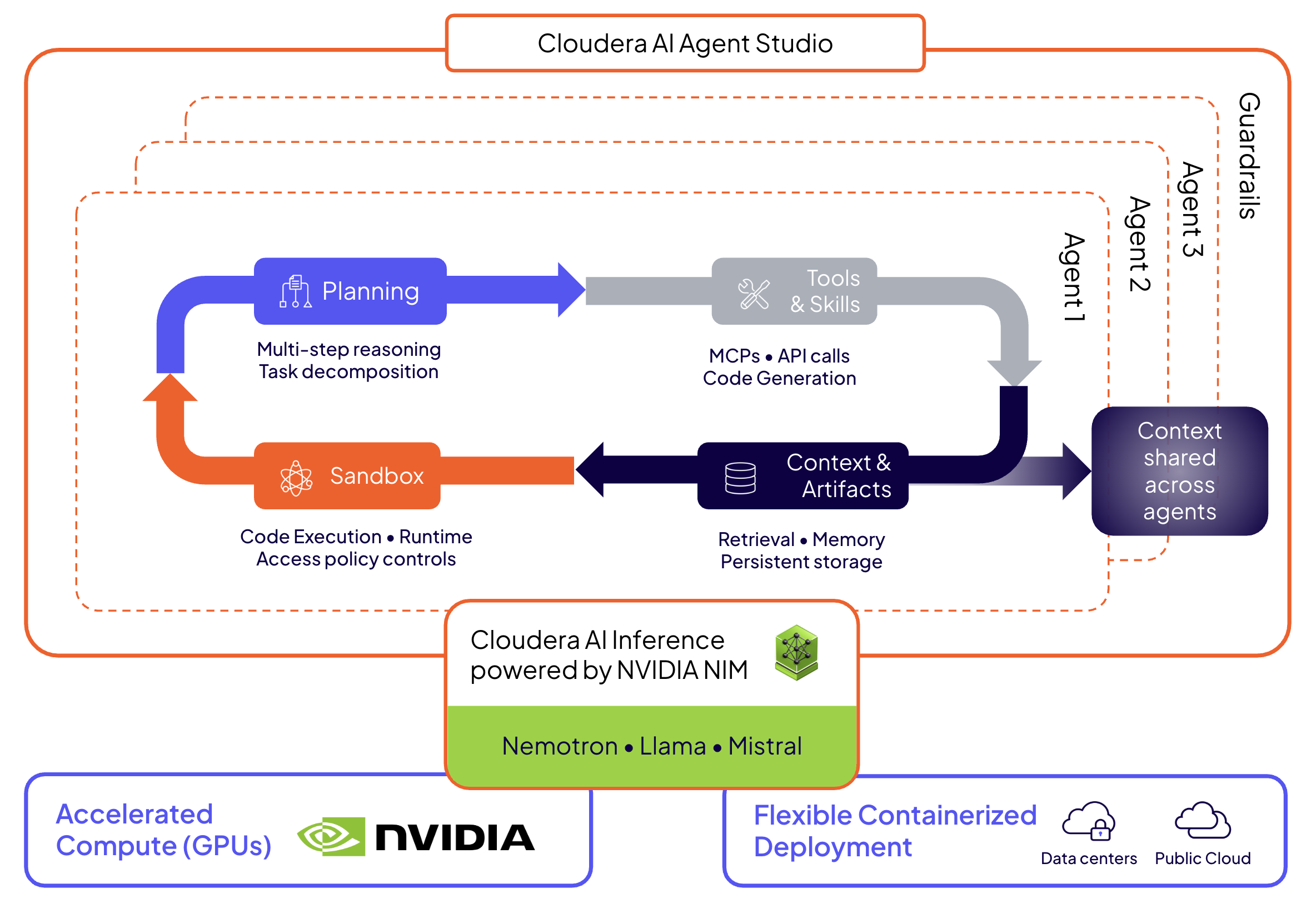 Agent Studio 3.0 Architecture
Cloudera Agent Studio 3.0 solves these structural challenges by running autonomous AI workflows directly where your data resides. Providing a governed execution engine running on existing Cloudera data service foundations, it systematically takes away each of the five structural barriers:
1. Immutable Audit Logs & Guardrails
Solving Black-Box Autonomy and Audit Liabilities
To mitigate regulatory risk and eliminate black-box execution, system activity records to structured, append-only audit logs. Compliance teams obtain end-to-end visibility capturing authenticated user identities, microsecond timestamps, operation types, resource identifiers, prompt inputs, and specific tool outputs.
Watch: Real-Time Guardrails in Action
Execution safety is enforced continuously via the following real-time mechanisms:
PII Masking: Anonymizes sensitive data before transmission to the model context window.
Content filters: Text-based deterministic rules that safeguard against prompt injection or block execution based on keywords.
Inline LLM Judge: Validates tool payload inputs and outputs against corporate compliance rules.
Custom guardrail: Programmatically enforces guardrails tailored to your business requirements.
For more details, explore our Guardrails Documentation.
2. Unified Dual-Track Workflows
Solving Governance Drift Across Siloed Teams
Agent Studio 3.0 unifies non-technical and technical development on a single orchestration engine, bridging the architectural split between business and engineering teams:
For Business Analysts: Build workflows visually using a catalog of pre-built tool templates and MCP connectors.
For AI Engineers: Write custom Python logic in Cloudera AI Workbench.
Because both paths compile to identical execution runtimes, they share identical platform security controls and eliminate shadow AI governance drift.
3. Controllable Function Calling & Sandboxing
Solving Fragile Prompting and Execution Retries
To eliminate fragile text-prompt execution chains, the platform leverages native LLM function-calling protocols. It passes formal JSON schemas to the model to generate strongly typed tool-call objects.
Container Sandboxing: Every agent process executes inside isolated container sandboxes configured with zero default system permissions, requiring explicit platform-level policy approval for privilege escalation.
Structured Planning: Before execution, agents construct a structured task plan so operators can monitor step-by-step progress deterministically.
4. Localized Compute Over Managed Data via MCP
Solving Cloud Egress Fees and Token Inflation
Agents execute directly against enterprise storage without data extraction or replication. Agents query structured analytics in Cloudera Data Warehouse, process streaming inputs through Cloudera DataFlow, and push outputs to Cloudera Data Visualization.
Connectors using the Model Context Protocol (MCP) bind agents directly to open table formats, while Cloudera Shared Data Experience (SDX) governance policies enforce role-based access controls and track metadata across every interaction—keeping data grounded and egress fees at zero.
5. Model Neutrality & FinOps Control
Solving API Lock-In and Fixed Compute Costs
Agent Studio 3.0 completely separates orchestration from underlying language models. Teams can target third-party APIs (OpenAI, Anthropic, Amazon Bedrock) or deploy open-source models locally through the Cloudera AI Inference service.
Switching model targets requires updating endpoint configurations in the orchestration layer without altering agent code or tool schemas. System architects lower total cost of ownership (TCO) by routing routine, high-volume function calls to smaller, locally hosted parameter models, reserving costly third-party API tokens strictly for complex multi-step reasoning.
Quantified Business Outcomes
Industry |
Operational Scenario |
Business Value |
Financial Services |
Underwrite thin-file commercial accounts across datasets exceeding 100 million records. |
Reduces underwriting cycles from days to minutes while generating regulator-ready audit trails. |
Telecommunications |
Process over 50,000 streaming events per second via Data Flow to detect churn signals. |
Triggers automated retention workflows in real time without moving data out of operational systems. |
Healthcare & Life Sciences |
Extract diagnostic codes from unstructured clinical charts across disparate health records. |
Accelerates clinical trial data processing within air-gapped runtimes. |
Insurance |
Correlate unstructured property site surveys with core transactional databases. |
Identifies omitted risk factors and automates cross-system data reconciliation. |
Software & Technology |
Execute Level-2 production incident triage within sandboxed container runtimes. |
Resolves application alerts and updates system state parameters without human escalation. |
Your Governed Agentic AI Future
Transitioning autonomous workflows from isolated prototypes to production systems requires solving the friction between rapid innovation and enterprise control. For too long, the gap between proof-of-concept and deployment forced teams to choose between the agility of autonomous AI and the security of centralized governance.
Cloudera Agent Studio 3.0 closes this gap.
By running compute directly where data resides, Agent Studio 3.0 systematically dismantles the five primary roadblocks to production AI: cloud egress fees, execution fragility, governance drift, audit ambiguity, and compute lock-in. Deploying enterprise agentic AI no longer requires an architectural trade-off.
Ready to take your AI agents to production? Get the strategies and skills to move from development to production in our 7-part Enterprise & Agentic AI webinar series.